Author: Shir Keren
Shir Keren works at AppMakers USA as a Project Manager and QA Analyst, keeping teams aligned and releases dependable. She supports planning, day to day coordination, and hands-on testing, with a strong focus on usability and detail. Outside the studio, she is usually hiking with her dog, cooking something new, or working on creative side projects.
If you’ve started pricing out a mobile app for your business, you’ve probably noticed the numbers don’t agree with each other. One quote comes in at $15,000. Another lands at $250,000 for something that sounds almost identical on paper. Neither quote is necessarily wrong. They’re just answering different questions, because “build a mobile app” can mean a dozen different projects depending on what’s actually inside it.
Here’s a more useful starting point than a single number: in 2026, most custom mobile apps for small and mid-sized businesses cost somewhere between $50,000 and $120,000, while full-featured platforms with AI, compliance requirements, or heavy backend logic push into the $150,000 to $500,000 range. The spread is wide because the cost isn’t really driven by “mobile app” as a category. It’s driven by seven or eight specific decisions you make before a single screen gets designed.
Why the Same “App Idea” Can Cost $20,000 or $200,000
The biggest cost driver isn’t the platform you choose. It’s complexity, and complexity hides in places founders don’t expect.
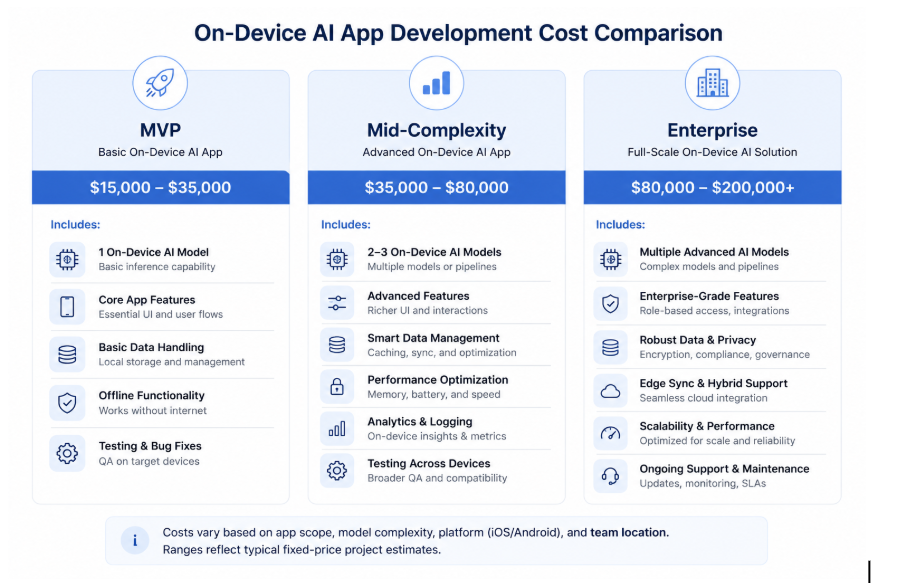
A simple MVP, built to test whether people actually want your idea, typically runs $25,000 to $60,000. It covers one platform, a handful of core screens, and just enough functionality to get real feedback from real users. This is the right starting point if you’re not yet certain your idea has a market.
A mid-complexity business app, the kind most companies actually end up building, costs more because it needs to do more. User accounts, push notifications, payment processing, third-party integrations, and a real backend all add development hours that an MVP skips entirely. This tier commonly lands between $50,000 and $150,000, and it’s where most serious business apps live.
Enterprise and AI-driven platforms are a different category altogether. Apps that handle live financial transactions, store regulated health data, or run agentic AI features carry compliance, security, and infrastructure costs that simpler apps never touch. These builds routinely run from $150,000 past $500,000, and that’s before factoring in ongoing maintenance.
The Costs Most Budgets Forget
Ask ten founders what an app costs, and most will quote the development number alone. That number is real, but it’s not the total. A realistic budget includes:
- Design, which typically runs 15 to 20 percent of total project cost and shapes how much rework happens later
- QA and testing, especially for apps targeting both iOS and Android, where device fragmentation adds real testing hours
- App store fees and compliance, including developer account costs and, for regulated industries, legal review
- Ongoing maintenance, which industry data consistently puts at 15 to 25 percent of the original build cost every year after launch
That maintenance line is the one most first-time app founders miss entirely, and it’s also the one that causes budget shock a year after launch. An app isn’t a one-time purchase. It’s closer to a piece of infrastructure that needs upkeep for as long as it’s live.
Native, Cross-Platform, or Web: The Choice That Changes Everything
Your platform decision affects cost more than almost any other single factor.
Building separately for iOS and Android with native code (Swift for iOS, Kotlin for Android) generally delivers the best performance and the smoothest access to device-specific features. It also means two codebases, two testing cycles, and two ongoing maintenance tracks, which is why it sits at the higher end of any pricing range.
Cross-platform frameworks like React Native and Flutter let one codebase run on both operating systems, typically cutting total cost by 30 to 50 percent compared to building twice. For most business apps, this has become the default choice in 2026, and the performance gap that used to matter has narrowed enough that it’s rarely the deciding factor anymore.
A web app or progressive web app skips native development entirely and tends to cost 20 to 35 percent less, with the tradeoff being limited offline functionality and no presence in the App Store or Google Play.
AI Features Now Have Their Own Line Item
Adding AI to a mobile app used to be optional. In 2026, it’s closer to a baseline expectation for any app competing in a crowded category, and it comes with its own budget line.
A basic AI recommendation engine or a chatbot built on a third-party API typically adds $10,000 to $40,000 to a project. Custom machine learning models trained on your own data start considerably higher and scale with data volume and complexity. The good news for most businesses is that existing AI APIs deliver strong results without the cost of building a custom model from scratch, which makes a $10,000 to $30,000 AI budget realistic for most mid-sized apps.
How to Actually Budget for This
The single best way to avoid a budget blowout is to get a detailed estimate before development starts, broken down by feature and phase rather than handed over as one lump number. A vague quote is a red flag. A specific one, tied to your actual feature list, is what protects your budget six months in.
Partnering with an established custom mobile app development company in the USA also matters more than founders expect going in. Experienced teams have already made the platform, framework, and architecture decisions on dozens of past projects, which means fewer expensive mistakes get discovered mid-build. The cheapest quote on the table is rarely the cheapest app by the time it actually ships.
The Bottom Line
There’s no single honest answer to “how much does a mobile app cost” because the question is really several questions stacked together: what tier of complexity, which platform strategy, how much AI, and how much ongoing maintenance you’re planning for. Get those four answers clear before you request a quote, and the numbers you get back will finally start making sense.