When you think of World War II films, you likely imagine gritty beach landings, somber memorials, or the tragic realities of the Holocaust. But what happens when you let a master of grindhouse cinema rewrite history? You get Inglourious Basterds.
Released in 2009 and directed by the iconic Quentin Tarantino, this film is less a history lesson and more a fairy tale of vengeance. For those asking, what is Inglourious Basterds about, the answer is surprisingly complex: it is a multi-layered, dialogue-driven thriller about Jewish soldiers and a cinema owner exacting bloody revenge on the Nazi regime.
Far from a standard war documentary, this film has cemented itself as a modern classic. Whether you are a cinephile or a casual viewer, understanding this film unlocks a unique conversation about the power of cinema itself. Here is why this brutal, hilarious, and brilliant movie is considered an absolute must-watch.
The Core Plot: Two Sides of the Same Violent Coin
At its heart, Inglourious Basterds is a story of convergence. The film unfolds in five chapters, following two distinct groups whose paths collide in a fiery Parisian climax.
Chapter One: The “Basterds” and Scalped Nazis
The first storyline introduces us to Lt. Aldo Raine (Brad Pitt), a hillbilly from Tennessee with a noose scar around his neck. He leads a squad of eight Jewish-American soldiers known as “The Basterds.” Their mission isn’t just to win the war; it’s psychological warfare. They parachute behind enemy lines in Nazi-occupied France to hunt, kill, and scalp Nazis.
The rules are simple: each man owes Raine 100 Nazi scalps. They leave one survivor alive from each massacre to spread the word of their terror. This narrative thread is pure grindhouse—explosive, gory, and punctuated by a baseball bat to the skull (courtesy of “The Bear Jew”). It answers what is Inglourious Basterds doing for the action fan? It delivers visceral, cathartic violence where the “bad guys” get exactly what they deserve .
Chapter Two: Shosanna and the Cinema of Fire
The second, more poignant thread follows Shosanna Dreyfus (Mélanie Laurent). As a teenager, she watched her family gunned down by SS Colonel Hans Landa (Christoph Waltz). She escapes and flees to Paris, where she assumes a new identity and takes over a small cinema.
Years later, a German war hero and propaganda star, Fredrick Zoller, becomes infatuated with her. He arranges for the premiere of his new film, Nation’s Pride, to be held in her theater—with Adolf Hitler, Hermann Göring, and Joseph Goebbels in attendance. Shosanna sees her chance for revenge. She plans to lock the doors and burn the theater down, turning the celluloid into a funeral pyre for the Third Reich .
Why “Inglourious Basterds” is a Must-Watch
If you are still wondering what is Inglourious Basterds offering that Saving Private Ryan or Band of Brothers does not, the answer lies in its audacity. It is not a film about the reality of war; it is a film about the emotion of war.
1. The Villain for the Ages: Hans Landa
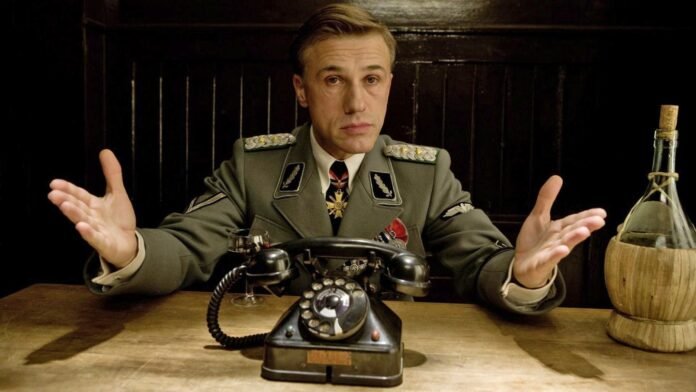
You cannot discuss this film without addressing the elephant in the room—or rather, the Jew Hunter in the room. Christoph Waltz’s portrayal of SS Colonel Hans Landa is arguably the greatest screen villain of the 21st century.
Landa is charming, intellectual, and utterly terrifying. He switches between English, French, German, and Italian with a smile, playing psychological chess with his victims before they even realize the game has started. Tarantino has a gift for dialogue, but Waltz brings a suspense to the opening farmhouse scene that is almost unbearable to watch. You feel the floorboards creaking under the hidden Jewish family, and you feel Landa’s cat-and-mouse precision. Waltz won the Academy Award for Best Supporting Actor for this role, and it is a masterclass in tension .
2. The Art of the “Spaghetti Western” Remix
Tarantino famously borrows from other genres. Here, he doesn’t just make a war movie; he makes a Spaghetti Western set in WWII. The music by Ennio Morricone, the wide shots of dusty French farms, and the “Once Upon a Time in… Nazi-Occupied France” title card deliberately evoke the films of Sergio Leone.
This stylistic choice distances the viewer from historical reality and places them in a mythic dreamscape. It signals to the audience: This is not a history book; this is a revenge fantasy. By doing so, Tarantino frees himself from the constraints of “accuracy” to deliver a film that feels righteous rather than depressing .
3. The “Bear Jew” and Representation
Historically, depictions of Jewish people during the Holocaust focused on victimhood. While that narrative is vital and true, Inglourious Basterds offered a different perspective: empowerment. Eli Roth’s character, Sgt. Donny Donowitz (The Bear Jew), beating Nazis to death with a bat is a visceral power fantasy.
For many viewers, watching a Jewish soldier literally smash the skulls of fascists was a release. As one review noted, the film asks, “What if there had already been a Mossad to counteract the SS?” It projects a modern toughness onto the past, allowing a generation to see their ancestors not just as victims, but as warriors .
The Power of Alternate History
One of the most controversial aspects—and the most brilliant—is the ending. Without spoiling every detail, the film culminates in the assassination of Adolf Hitler. This never happened. Hitler died by suicide in a bunker in 1945.
Tarantino knows this. He isn’t stupid; he is a historian of film, not a documentarian. By killing Hitler in a movie theater (literally by the “magic” of film), Tarantino makes a massive statement: Cinema is more powerful than fascism.
Critics initially balked at this “rewriting” of history. However, audiences embraced it because Inglourious Basterds is not about what did happen, but what should have happened. As one writer from Entertainment Weekly argued, the film operates as a “wish-fulfilling B-movie fever dream” . It turns history into a pulp novel, and in doing so, offers a catharsis that realist war films cannot provide.
The Dialogue: More Than Just Words
For fans of Tarantino, the answer to what is Inglourious Basterds is: It is a dialogue film. There is less action than you remember. The most famous scene (the basement tavern) contains only 37 seconds of gunfire, preceded by 20 minutes of talk.
In the tavern scene, British Lt. Archie Hicox (Michael Fassbender) gives himself away not by his gun, but by his hand gesture. He orders three drinks and holds up three fingers in the wrong way (the British “index, middle, ring” vs. the German “thumb, index, middle”). This tiny detail leads to a massive shootout.
This attention to linguistics (characters constantly shifting languages to reveal deception) makes the film intensely rewatchable. You hang on every word because you know a slip of the tongue means a bullet to the head.
Practical Insights for First-Time Viewers
If you are ready to watch, here are a few tips to enhance your experience:
-
Turn on Subtitles: Even if you speak English, characters switch fluidly between French and German. Tarantino deliberately leaves many scenes un-translated in the theater mix to make you feel as lost as the characters.
-
Embrace the Length: The runtime is 153 minutes, but the film is structured into distinct chapters. Treat it like reading a book—you can mentally pause between chapters to digest the tension.
-
Lower Your Expectations for “Action”: If you expect a non-stop shootout like John Wick, you will be bored. Go in expecting a thriller. The violence is sparse but explosive.
-
Research the References: Look up the original 1978 film The Inglorious Bastards to see how Tarantino pays homage to exploitation cinema .
-
Don’t Fact-Check in Real Time: Let go of your knowledge of WWII. Tarantino builds a world where the laws of physics and history bend to the will of revenge. Just enjoy the ride.
For a deeper dive into the cinematic techniques and references, you can explore this detailed analysis on Den of Geek’s retrospective of Inglourious Basterds, which breaks down the film’s legacy ten years later.
Verdict: A Masterpiece of Revenge
So, what is Inglourious Basterds? It is a Jewish revenge fantasy. It is a love letter to cinema. It is a suspense thriller set in a basement bar. It is a high-stakes game of “Spot the Spy.” More than anything, it is a film that argues that the silver screen can change the world—literally.
It is a must-watch because it challenges the very nature of how we view war films. It asks us to trade accuracy for emotion, and in exchange, it gives us the satisfaction of watching evil meet a fiery end. Brad Pitt’s final line, “I think this just might be my masterpiece,” is Tarantino speaking directly to the audience. He knows he made something special.
Whether you love it for the brutality, the tension, or the historical “what if,” Inglourious Basterds remains a vital, explosive piece of modern cinema that no fan of film should miss.
Conclusion
In a genre crowded with stories of loss, Inglourious Basterds stands alone as a story of victory. It is loud, it is unapologetically violent, and it is deeply, profoundly satisfying. By blending WWII iconography with the stylings of a B-movie, Tarantino created a film that is timeless.
Actionable Takeaways:
-
Watch for Christoph Waltz: His performance is a masterclass in screen acting.
-
Embrace the Alternate History: View the film as a “fairy tale” to unlock its true enjoyment.
-
Listen to the Dialogue: The words are the weapons; pay attention to the hand gestures and language switches.
-
Don’t forget Shosanna: While the Basterds get the headlines, Shosanna is the soul and the brains of the operation.