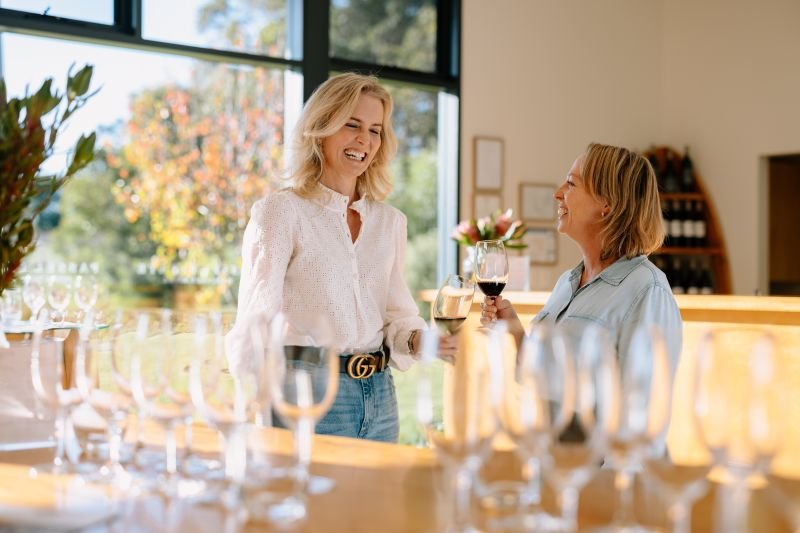
At first glance, it looks like many of the region’s premium vineyards. Neatly managed rows. A cellar door that moves at its own pace. Nothing out of place.
It fits the general idea of a Margaret River wine estate.
But in an increasingly competitive tourism and wine market, where many premium vineyards compete on similar ground, differentiation is becoming less about product alone and more about positioning.

Some properties are starting to stand out for a different reason entirely.
If you want to get a sense of it, you can explore this Margaret River wine estate.
That surface read doesn’t hold for long.
The property is also home to the Western Ringtail Possum, a critically endangered species native to the southwest of Western Australia, and its presence has shaped how the land is used in ways that aren’t immediately obvious.
It becomes clearer later in the day. Not dramatically. Just a shift. The vineyard slows off a bit, and the surrounding bushland starts to feel more active than it did an hour earlier.
A Different Starting Point
Most vineyards begin with production in mind.
Soil, sunlight, yield. Everything builds out from there. The land is adjusted to suit the vines.
Here, it didn’t quite happen like that.
Before anything was planted, sections of native vegetation were kept in place. Not as a feature. Just left as they were. Movement corridors were maintained so wildlife could still pass through the property without interruption.
That meant working around what was already there. Not clearing first and figuring it out after.
From a business perspective, that’s not the most efficient approach.
But it does create something else, a point of difference that’s difficult to replicate.
The Business Trade-Off
Working this way introduces constraints.
There’s less land available for planting. Expansion becomes more complex. Vineyard operations need to be more deliberate, often requiring additional planning and ongoing management.
From a purely production-driven lens, those factors can look like limitations.
But from a positioning standpoint, they create something more valuable.
In markets where many offerings appear similar on the surface, distinctiveness becomes a competitive advantage. And that advantage is often built not by adding more, but by choosing what not to remove.
That’s where this approach starts to shift from a constraint into a strategic asset.
Where It Starts to Feel Different
There isn’t a clean edge between vineyard and bush.
It blends. Sometimes gradually, sometimes in a way that’s easy to miss if you’re not looking for it.
Regenerated areas sit alongside planted rows. The vineyard occupies its space, but it doesn’t take over completely.
That does limit things. There’s less land to work with. Expansion isn’t as simple. Everything tends to be managed more carefully.
But that constraint is also what gives the property its identity and, increasingly, its positioning.
And once visitors leave, it shifts again. The land goes back to doing what it was already doing.
Why Conservation Becomes a Differentiator
In a region known for consistency and quality, differentiation often comes down to experience and story.
Conservation, in this case, isn’t presented as a marketing hook. But it inevitably becomes part of how the property is perceived.
From a business standpoint, this shifts the winery out of a purely product-driven category and into an experience-led one.
That distinction matters.
It changes how the brand is remembered, how it’s talked about, and how it competes within a crowded wine tourism market.
Visitors aren’t just engaging with a winery. They’re stepping into a working example of how land, production, and ecology can coexist.
And that’s a narrative that carries.
Conservation in Practice
Some of the conservation work here is visible. Some of it isn’t.
Nest boxes have been installed across the property to support populations of the Western Ringtail Possum, particularly in areas where natural hollows aren’t as common. It’s a small intervention, but a practical one.
Then there’s the less obvious part.
Habitat corridors are kept open so animals can move between feeding and nesting areas without being cut off. That matters more than it sounds. Without that movement, populations don’t hold up over time.
And it’s not just about one species.
There’s ongoing work around native vegetation. Keeping what’s there, bringing some of it back where it’s been lost. Which also means removing what doesn’t belong. Invasive plants, including arum lilies, are actively managed so they don’t crowd out everything else.
None of this happens quickly.
There’s no clear “before and after.” It’s a gradual shift. Systems re-establishing themselves over time.
A Broader Read on Margaret River
The Margaret River region is usually talked about in terms of consistency.
Climate. Proximity to the ocean. Reliable quality across producers.
That still holds.
But properties like this sit slightly outside that usual framing. Not in opposition to it, just adding another dimension.
Something that’s less about how the wine performs, and more about how the land is handled alongside it.
For visitors, it’s subtle. You might not notice it straight away. But it’s there, in the way the vineyard gives way to bush, or how quiet it feels once you step a little further out.
What Other Businesses Can Take From This
While this is a vineyard, the underlying principle extends well beyond wine.
Businesses that build around what already exists – rather than forcing uniformity – can create differentiation that competitors struggle to replicate.
It’s not always the most efficient path.
It can introduce complexity. It can limit scale.
But it also creates identity.
And in competitive markets, identity is often what separates businesses that are compared on price from those that are remembered for something else entirely.
The Wine Still Needs to Stand Up
And it does.
The wines are produced in relatively small volumes and reflect the cooler maritime conditions of the region. Structured. Balanced. Built to hold over time rather than push for immediate impact.
There’s a level of restraint to them.
Nothing feels overworked or exaggerated. Which, in a way, mirrors what’s happening across the rest of the property.
Not a Different Message, Just a Different Approach
There’s a tendency to define vineyards by what they produce.
Fair enough.
But increasingly, it’s also about what they leave in place.
At Passel Estate, that isn’t positioned as a feature or a selling point. It’s simply part of how things are done. Something that sits underneath everything else.
And maybe that’s why it works.
It doesn’t try to stand apart.
It just never fully followed the same path to begin with.
Related posts:
![WhatsApp verification code not received]()
Why Your WhatsApp Verification Code Not Received and How to Fix It Quickly
General![Instagram login error today]()
Instagram Login Error Today: Is Instagram Down or Just a Temporary Glitch?
General![pit viper sunglasses worn by tyler robinson killer]()
Ultimate Guide to Pit Viper Sunglasses Worn by Tyler Robinson Killer
General
The Complete Guide to Understanding mannacote? Benefits and Uses
General![Poppers Aromas: 7 Powerful Reasons This EU Store Stands Out]()
Poppers Aromas: 7 Powerful Reasons This EU Store Stands Out
General![chingyu_w_rewardver_sadness]()
Understanding Chingyu_W_RewardVer_Sadness: Your Guide to This Unique Sims 4 Trait Mod
General