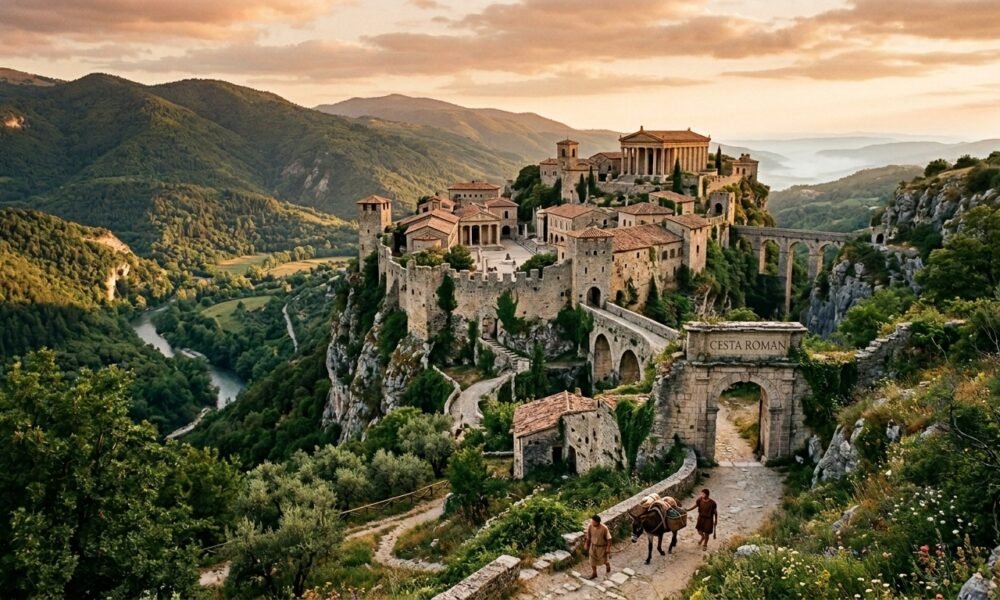
Cesta Roman, translating to “Roman road” in languages like Slovenian and Croatian, refers to the remarkable network of highways built by the ancient Romans. These engineering feats were not just paths through the landscape; they were the arteries of one of history’s greatest empires. Spanning over 80,000 kilometers (about 50,000 miles) of paved roads at their peak, they facilitated military conquests, trade, communication, and cultural exchange across Europe, North Africa, and the Middle East.
In this detailed guide, we’ll dive deep into the history, construction techniques, iconic examples, and enduring impact of Cesta Roman. Whether you’re a history buff planning a trip or simply curious about ancient innovations, this article provides everything you need to appreciate these enduring wonders.
The Historical Origins and Importance of Cesta Roman
The construction of Roman roads began around 300 BC during the Roman Republic and continued through the Empire’s expansion. The first major highway, the Via Appia (Appian Way), was initiated in 312 BC by Appius Claudius Caecus to connect Rome with southern Italy.
These roads were crucial for maintaining control over vast territories. Roman legions could march up to 30-40 kilometers per day on well-maintained surfaces, allowing rapid response to rebellions or invasions. Beyond military use, Cesta Roman supported economic growth by enabling safe transport of goods, from grain and olive oil to luxury items like silk and spices.
Key Milestones in Roman Road Development:
- Republic Era (300-27 BC): Focus on Italy with roads like Via Appia and Via Flaminia.
- Imperial Expansion (27 BC onward): Networks extended to provinces in Gaul, Hispania, Britannia, and beyond.
- Peak under Trajan and Hadrian: Standardized maintenance systems and milestones (stones marking distances from Rome).
The proverb “All roads lead to Rome” originated from this interconnected system, symbolizing the city’s centrality.
Engineering Marvels: How Romans Built Enduring Roads
What made Cesta Roman so durable? Roman engineers employed sophisticated, multi-layered construction techniques that many modern roads still emulate.
Construction Layers and Techniques
A typical Roman road featured:
- Foundation (Statumen): Large stones or rubble for stability.
- Base (Rudus): Crushed stone mixed with lime.
- Nucleus: Concrete-like layer using pozzolana (volcanic ash) for strength.
- Surface (Summum Dorsum): Paved with large stone slabs or gravel, often cambered (slightly arched) for drainage.
Roads were built straight where possible, using surveying tools like the groma. They included bridges, tunnels, and viaducts to overcome natural obstacles. Drainage ditches and curbs prevented water damage, a common issue for modern infrastructure.
Expert Tip: When visiting preserved sections, notice the slight curvature— this engineering detail has allowed many roads to survive floods and frost for over 2,000 years.
Famous Examples of Cesta Roman Around the World
Several standout routes exemplify the brilliance of Roman road-building.
The Via Appia (Appian Way) in Italy
Often called the “Queen of Roads,” this route from Rome to Brindisi remains one of the best-preserved. Sections near Rome feature original paving stones flanked by ancient tombs and cypress trees, offering a serene walk through history.
Via Augusta in Spain
Stretching across the Iberian Peninsula, this road connected key trade hubs and is still traceable today.
Rimska Cesta in Slovenia
In Slovenia, “Rimska cesta” (Cesta Roman) highlights local heritage. A significant route ran from Aquileia through Emona (modern Ljubljana), Celeia (Celje), and Poetovio (Ptuj). Visitors can see well-preserved sections and archaeological sites in Celje, including one of Slovenia’s largest exposed Roman streets.
Other notable roads include the Via Aurelia along the Italian coast and networks in Britain like the Fosse Way.
Benefits and Drawbacks of the Roman Road System
Benefits:
- Military Efficiency: Enabled fast troop movements and supply lines.
- Economic Boost: Standardized travel reduced costs and risks for merchants.
- Cultural Integration: Facilitated the spread of Roman law, language, and technology.
- Longevity: Many segments remain usable or form the basis of modern highways.
Drawbacks:
- High Cost: Construction and maintenance required massive resources and labor (often slaves or soldiers).
- Environmental Impact: Quarrying and deforestation for materials altered landscapes.
- Strategic Vulnerability: Well-built roads could also be used by invaders.
Overall, the advantages far outweighed the challenges, contributing to Rome’s dominance for centuries.
How to Explore Cesta Roman Today: Practical Tips for Travelers
Exploring ancient Roman roads is an unforgettable experience. Here’s actionable advice:
- Start in Italy: Walk the Via Appia Antica on a guided tour. Rent a bike for easier navigation.
- Slovenia and Balkans: Visit Celje or Ljubljana for accessible sites. Look for “Rimska cesta” signs.
- Preparation: Wear comfortable shoes, bring water, and use apps like Google Maps overlaid with historical layers.
- Best Time: Spring or fall to avoid summer crowds and heat.
- Combine with Other Sites: Pair road explorations with nearby ruins, museums, or aqueducts for context.
Actionable Checklist:
- Research local archaeological parks in advance.
- Join a history-focused tour for expert insights.
- Photograph milestones and compare with modern roads.
For tech enthusiasts interested in immersive setups while planning trips or sim racing historical routes, consider a mobile triple screen setup simracing experience to virtually traverse these paths.
Modern Legacy: How Cesta Roman Influences Today’s Infrastructure
Many contemporary European roads follow Roman alignments. For instance, parts of the A1 motorway in Italy trace the Via Appia. Engineering principles like layered foundations, drainage, and straight alignments remain foundational in civil engineering.
Archaeologists continue discovering new segments, and preservation efforts ensure these sites remain accessible. UNESCO and national heritage organizations protect key areas.
Related Topics: Deepening Your Understanding of Roman Engineering
Cesta Roman and Trade Routes
Roads integrated with sea ports and rivers, creating a multimodal network.
Military Camps and Waystations
Roads featured mansiones (inns) and mutationes (horse-changing stations) every 20-30 km.
Technological Innovations
Romans adapted Etruscan and Greek techniques, perfecting concrete and surveying.
Preservation Challenges
Modern urbanization threatens some sites, making conservation vital.
Virtual and Educational Resources
Online reconstructions and museum exhibits bring Cesta Roman to life for global audiences.
Comparison: Roman Roads vs. Other Ancient Networks
Compared to Persian Royal Roads or Inca trails, Roman roads stood out for their durability, standardization, and extensive paving. While Incan roads excelled in mountainous terrain, Roman engineering emphasized all-weather usability across diverse landscapes.
Conclusion
Cesta Roman represents more than ancient infrastructure—it embodies human ingenuity, resilience, and the drive to connect civilizations. From the strategic Via Appia to local treasures like Slovenia’s Rimska cesta, these roads transformed the ancient world and left an indelible mark on our modern one.
By understanding their history, engineering, and legacy, readers can better appreciate how foundational choices shape societies. Whether planning a historical adventure or simply reflecting on innovation, take action: visit a preserved site, read primary sources like those on Wikipedia, or explore resources from Britannica and Forbes for deeper dives.
Smart exploration of Cesta Roman not only enriches your knowledge but connects you to the enduring spirit of the Roman Empire. Start your journey today—history awaits just beyond the next bend in the road.
Related posts:

Advizzo Product Features Reporting Dashboards Analytics Insights Explained
Blogs
Why Leadership Is Useful In Creating Psychological Safety
Blogs
What Is Time Dilation?
Blogs![telephone prefix 216]()
What Is Telephone Prefix 216?
Blogs![Crestwood High School Baulkham Hills NSW]()
Crestwood High School Baulkham Hills NSW: Address, Location, and Comprehensive Guide
Blogs![spectra home tamara day warwick poem apple chair]()
Spectra Home Tamara Day Warwick Poem Apple Chair: Timeless Elegance Meets Everyday Durability
Blogs

.png?w=300&resize=300,300&ssl=1 "Why Leadership Is Useful In Creating Psychological Safety")