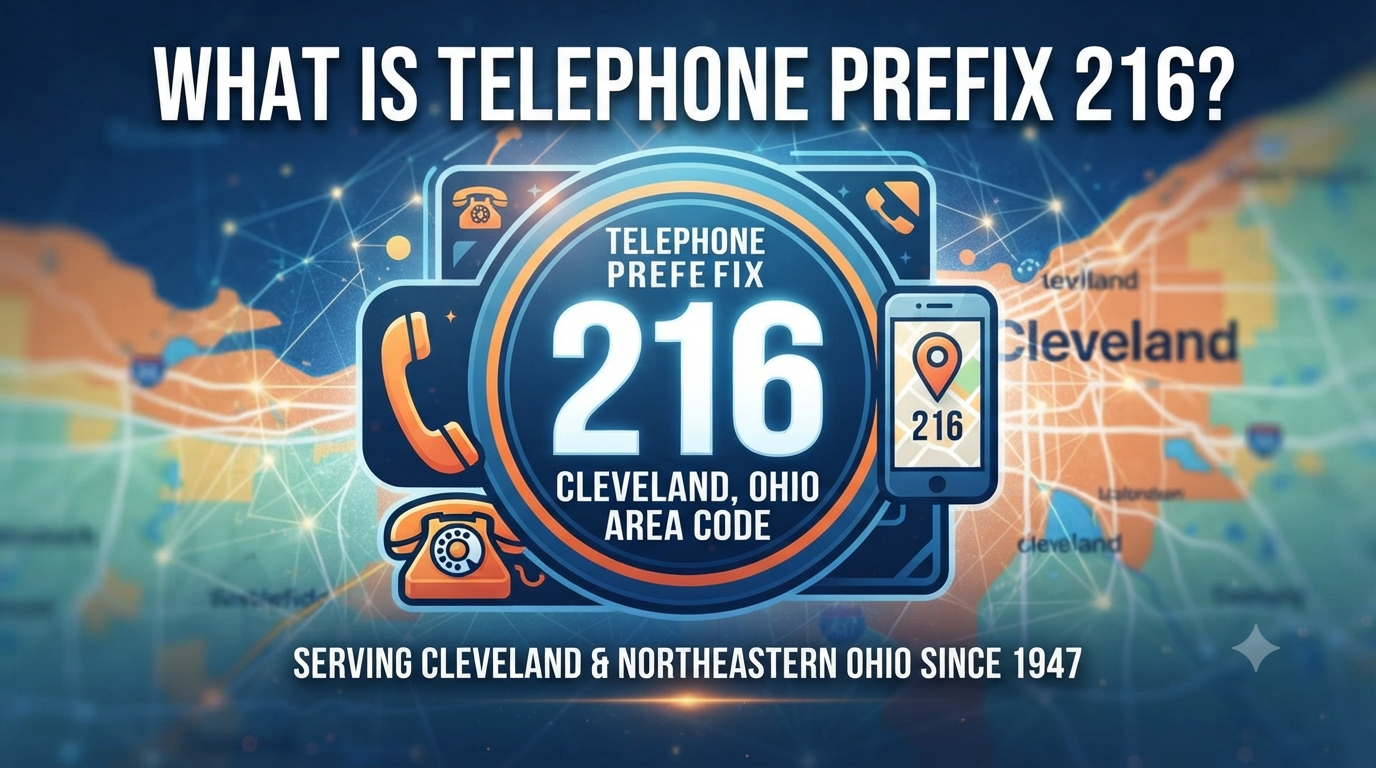
Telephone prefix 216 refers to the three-digit area code (NPA) in the North American Numbering Plan that identifies phone numbers in northeastern Ohio, primarily Cleveland and its inner-ring suburbs. Unlike many urban areas that now use overlays, 216 stands alone as the sole area code for its geographic territory.
This makes it highly recognizable. Locals often affectionately refer to Cleveland itself as “the 216.” In a full phone number, it appears as 216-XXX-XXXX, where the next three digits (the central office code or prefix) further pinpoint location or carrier, followed by the four-digit line number.
Key facts at a glance:
- State: Ohio
- Primary City: Cleveland
- County: Cuyahoga County
- Time Zone: Eastern Time (ET)
- In Service Since: January 1, 1947
- Overlay Status: None (unique in Ohio for a major urban area)
- Projected Exhaustion: Not until around 2046
This stability contributes to the strong local identity tied to the telephone prefix 216.
History of the 216 Area Code
The story of telephone prefix 216 begins with the post-World War II boom in telecommunications. In 1947, AT&T and the Bell System introduced the NANP to standardize dialing across the United States and Canada. Ohio was divided into four initial area codes, with 216 assigned to the northeastern quadrant—from Lorain to Youngstown.
As the region grew, so did the demand for phone numbers due to population increases, fax machines, pagers, and eventually cell phones. Significant splits occurred:
- 1996: The southern portion (including Akron, Canton, and Youngstown) became area code 330.
- 1997: The eastern and western suburbs were assigned area code 440, narrowing 216 to Cleveland proper and its immediate inner suburbs.
These changes reflect the dynamic nature of telephone infrastructure. Despite multiple divisions, 216 retained its core identity. Today, it remains one of the original 86 area codes still in active use without an overlay.
Timeline of Key Milestones
- 1947: 216 established as one of Ohio’s first area codes.
- 1996: Split creating 330.
- 1997: Split creating 440.
- Present: No overlay; sufficient numbers projected through 2046.
This history underscores how telephone prefix 216 has evolved while staying rooted in Cleveland’s identity.
Geographic Coverage and Major Cities
The telephone prefix 216 primarily serves Cuyahoga County, focusing on Cleveland and about 30-34 inner-ring suburbs. It covers a population of roughly 1.26 million people.
Key Cities and Communities
- Cleveland: The heart of the region, home to major attractions like the Rock & Roll Hall of Fame.
- Lakewood: Vibrant west-side suburb known for its historic homes and lakefront.
- Euclid: Northeast suburb with industrial and residential mix.
- Parma: One of the largest suburbs, family-friendly.
- Cleveland Heights and Shaker Heights: Affluent areas with strong cultural scenes.
- Garfield Heights, Maple Heights, Warrensville Heights: Diverse south-side communities.
- Others: Brook Park, Berea, South Euclid, East Cleveland, Beachwood, Independence, and more.
The area code boundaries are tightly drawn around the urban core, distinguishing it from outer suburbs in 440.
Zip Code Examples: 44101–44110, 44113, 44114, and many others in the 441xx range.
How to Dial Numbers with Telephone Prefix 216
Dialing is straightforward in this single-area-code region:
- Local calls (within 216): 7-digit or 10-digit dialing (10-digit increasingly standard).
- From outside 216 but within the US: 1 + 216 + 7 digits.
- International calls: 011 + 1 + 216 + 7 digits (or +1 216 from mobile).
Practical Example: Calling a Cleveland business from New York—dial 1-216-XXX-XXXX. From a Cleveland landline to another local number, 216-XXX-XXXX or just the last seven digits may work depending on your carrier.
Tip for Beginners: Always use 10-digit dialing to avoid issues, especially as carriers phase out 7-digit options nationwide.
Major Carriers and Prefixes in 216
Hundreds of prefixes (NXX codes) are active under telephone prefix 216. Major carriers include:
- Ohio Bell / AT&T (Ameritech legacy)
- Verizon Wireless
- T-Mobile
- Sprint (now part of T-Mobile)
- Bandwidth.com and other VoIP providers
Wireless and landline prefixes are well-distributed. You can look up specific NXX codes via NANPA resources for carrier details.
Getting Your Own 216 Phone Number
Whether relocating, starting a business, or wanting a local presence:
- Traditional Carriers: Visit Verizon, AT&T, or T-Mobile stores in Cleveland for new lines.
- VoIP and Virtual Numbers: Services like Google Voice, Burner, or business-focused providers allow acquiring 216 numbers remotely.
- Porting: Transfer an existing number or request a local one.
Business Benefits: A 216 number builds instant trust with Cleveland customers, ideal for real estate, healthcare, restaurants, or professional services.
Example Scenario: A remote consultant targeting Ohio clients gets a 216 number via VoIP to appear local without moving.
Benefits and Drawbacks of a 216 Area Code Number
Benefits:
- Strong local recognition and pride.
- No overlay confusion.
- Established infrastructure with reliable service.
- Cultural association with Cleveland’s revitalization (sports, arts, healthcare).
Drawbacks:
- Limited availability for new assignments in high-demand prefixes.
- Geographic restriction for “local” perception outside inner suburbs.
- Potential for higher demand and competition in desirable exchanges.
Overall, the pros far outweigh the cons for those connected to the region.
Surrounding Area Codes and Ohio Phone Geography
- 440/436: Outer suburbs and western/eastern areas.
- 330/234: Akron, Canton, Youngstown (southern split from original 216).
- Others: 614 (Columbus), etc.
Understanding these helps with call routing and business targeting.
Economic and Cultural Significance
Cleveland’s economy—healthcare (Cleveland Clinic), manufacturing, finance, and tourism—relies heavily on robust communications. The telephone prefix 216 symbolizes stability and community in a city known for its “rock and roll” spirit and comeback narrative.
Many businesses use 216 numbers in marketing to evoke authenticity. Culturally, it’s woven into local sports fandom (Cavaliers, Browns, Guardians) and neighborhood identities.
Expert Tips for Managing 216 Numbers
- Call Screening: Use apps to identify legitimate local calls.
- Business Setup: Pair with CRM tools for better customer engagement.
- Number Conservation: Choose VoIP for flexibility and features like call forwarding.
- Future-Proofing: Monitor NANPA updates for any changes, though none are imminent.
Actionable Advice: For beginners, start with a virtual provider to test a 216 number before committing to a full plan.
How to Identify or Lookup 216 Numbers
Reverse lookup tools, carrier apps, or sites like Whitepages help verify callers. Always exercise caution with unknown numbers, but remember that 216 calls are typically legitimate local ones.
The Future of Telephone Prefix 216
Projections indicate no need for relief until 2046, preserving its single-code status. Advancements in VoIP, 5G, and beyond will continue enhancing service without disrupting the core identity.
Conclusion
The telephone prefix 216 is the enduring voice of Cleveland—reliable, recognizable, and rooted in history. From its 1947 origins through splits and into the digital age, it connects a dynamic region while maintaining uniqueness. Whether you’re a resident cherishing local ties, a business seeking authentic presence, or someone exploring Ohio’s telecom landscape, understanding 216 empowers better communication decisions.
Key Takeaways:
- Prioritize 10-digit dialing.
- Leverage virtual numbers for flexibility.
- Embrace its cultural significance for stronger local connections.
- Stay informed via official NANPA sources.
Make informed choices for your phone needs and celebrate the community behind every 216 call. For more on Cleveland or telecom trends, explore trusted resources like the North American Numbering Plan Administrator or Wikipedia’s detailed entry on area codes.
Related posts:
![Crestwood High School Baulkham Hills NSW]()
Crestwood High School Baulkham Hills NSW: Address, Location, and Comprehensive Guide
Blogs![spectra home tamara day warwick poem apple chair]()
Spectra Home Tamara Day Warwick Poem Apple Chair: Timeless Elegance Meets Everyday Durability
Blogs
How to Craft a Highly Personalized Message for Prospect Based on Responsibilities
Blogs![Life After Separation Is About More Than Starting Again]()
Life After Separation Is About More Than Starting Again
Blogs
Bachelorette Party Ideas for 2026: Themes, Destinations & Planning Tips
Blogs
Why Is HDHub4u Popular?
Blogs