What Does “The Following Data Were Reported by a Corporation” Mean?

 Business
 What Does “The Following Data Were Reported by a Corporation” Mean?
The phrase “the following data were reported by a corporation” often appears in accounting textbooks, exam questions, and financial analysis scenarios. It introduces key metrics such as authorized shares, issued shares, treasury shares, or other financial figures that help calculate outstanding shares, equity values, or performance indicators. Understanding this reporting mechanism is essential for investors, managers, accountants, and business students who interpret corporate disclosures.
This article explores the significance of corporate data reporting, the types of information typically shared, best practices for accurate and transparent reporting, and practical ways businesses can leverage such data for better decision-making. Whether you are analyzing a balance sheet or preparing stakeholder communications, mastering how corporations present their numbers builds trust and drives strategic growth.
What Does “The Following Data Were Reported by a Corporation” Mean?
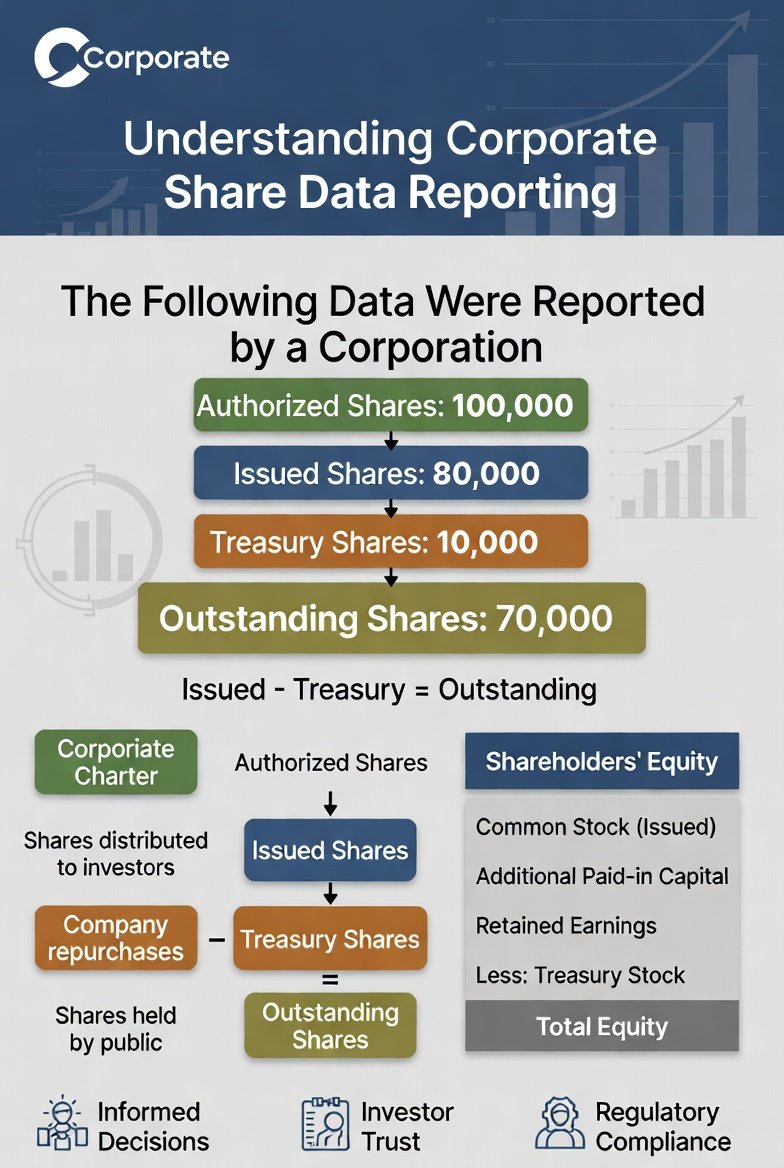
In accounting and finance contexts, the expression “the following data were reported by a corporation” serves as a standard introductory phrase for presenting raw figures from a company’s records. It commonly precedes details like:
- Authorized shares (maximum shares a company can issue per its charter)
- Issued shares (shares actually distributed to shareholders)
- Treasury shares (shares repurchased and held by the company)
- Outstanding shares (issued shares minus treasury shares)
These figures help compute important equity metrics. For instance, outstanding shares determine ownership percentages, earnings per share (EPS), and voting rights.
Example: “The following data were reported by a corporation: Authorized shares 50,000; Issued shares 40,000; Treasury shares 5,000.” The number of outstanding shares would then be 35,000 (40,000 – 5,000). This simple calculation affects dividend distributions, market capitalization, and investor perceptions.
Such phrasing appears frequently in educational materials and professional exams because it mirrors real-world financial statement footnotes and regulatory filings. Corporations use it to maintain clarity and formality when disclosing data to external parties.
Why Corporate Data Reporting Matters
Transparent reporting of financial and operational data fosters trust among stakeholders, including investors, regulators, employees, and partners. When a company clearly states “the following data were reported by a corporation,” it signals accountability and adherence to standards like Generally Accepted Accounting Principles (GAAP) or International Financial Reporting Standards (IFRS).
Key Benefits:
- Informed Decision-Making: Accurate data helps executives allocate resources, forecast growth, and identify risks.
- Investor Confidence: Clear disclosures reduce uncertainty and can positively influence stock prices.
- Regulatory Compliance: Public companies must file reports with bodies like the U.S. Securities and Exchange Commission (SEC), ensuring data integrity.
- Operational Efficiency: Internal teams use reported metrics to benchmark performance and improve processes.
Poor reporting, on the other hand, can lead to misinterpretations, legal issues, or loss of stakeholder trust. In today’s data-driven economy, businesses that excel at reporting gain a competitive edge.
Common Types of Data Reported by Corporations
Corporations regularly share various categories of information. Here are the most important ones:
- Share Capital Data Details on authorized, issued, and treasury shares are foundational for equity analysis.
- Financial Statements
- Income Statement (revenue, expenses, net profit)
- Balance Sheet (assets, liabilities, equity)
- Cash Flow Statement (operating, investing, and financing activities)
- Statement of Changes in Equity
- Performance Metrics Revenue growth, profit margins, return on equity (ROE), earnings before interest and taxes (EBIT), and key performance indicators (KPIs) tailored to the industry.
- Operational Data Inventory levels, accounts receivable/payable aging, production volumes, or customer acquisition costs.
- Non-Financial Data Sustainability metrics, employee headcount, or market share—especially relevant under evolving ESG (Environmental, Social, Governance) reporting expectations.
Practical Insight: A manufacturing firm might report production output and raw material costs alongside financial figures. This holistic view allows analysts to connect operational efficiency with bottom-line results.
Best Practices for Effective Corporate Data Reporting
To ensure reports are reliable and useful, corporations should follow these proven practices:
- Adhere to Standards: Use GAAP or IFRS consistently for comparability across periods and companies.
- Ensure the Four C’s of Data: Keep data Correct, Current, Complete, and Consistent.
- Automate Where Possible: Leverage accounting software to reduce manual errors and speed up data collection.
- Provide Context: Numbers alone can mislead. Explain trends, variances, and external factors (e.g., inflation or market shifts).
- Use Visual Aids: Charts, graphs, and dashboards make complex data more accessible.
- Maintain Internal Controls: Segregate duties, conduct regular reconciliations, and review journal entries to prevent fraud or errors.
Tip for Small Businesses: Even if not publicly traded, adopt similar disciplines. Monthly bank reconciliations and budget-vs-actual comparisons can prevent cash flow surprises.
How to Analyze Data When “The Following Data Were Reported by a Corporation”
When you encounter this phrase in a report or problem, follow a structured approach:
- Identify Key Figures: Note authorized vs. issued vs. treasury shares.
- Perform Calculations:
- Outstanding shares = Issued shares – Treasury shares
- Book value per share = Total equity ÷ Outstanding shares
- Compare Over Time: Look for trends in share repurchases or new issuances.
- Assess Implications: High treasury shares might indicate confidence in undervaluation, while new issuances could fund expansion.
Real-World Example: Suppose a tech startup reports increasing issued shares due to employee stock options. Investors might view this positively as it aligns incentives but could dilute existing ownership if not managed well.
Challenges in Corporate Data Reporting and How to Overcome Them
Common hurdles include data silos, manual processes, regulatory changes, and ensuring relevance to diverse audiences.
Solutions:
- Integrate systems (ERP, CRM, accounting software) for unified data.
- Train teams on reporting standards and communication skills.
- Conduct regular audits and peer reviews.
- Tailor reports: Executives may need high-level summaries, while analysts want granular details.
For global corporations, currency translation and differing tax laws add complexity—professional advice or specialized software helps here.
The Role of Technology in Modern Corporate Reporting
Advancements in cloud-based tools, AI, and data analytics have transformed how corporations handle reporting. Real-time dashboards allow instant access to metrics, while automation handles repetitive tasks like data aggregation.
Businesses can now generate interactive reports that let stakeholders drill down into specifics. This transparency strengthens relationships and supports faster, evidence-based decisions.
Actionable Tip: Start with free or affordable tools for basic financial tracking, then scale to enterprise solutions as your company grows. Regular backups and cybersecurity measures protect sensitive data.
Linking Corporate Reporting to Business Strategy
Effective reporting is not just about compliance—it’s a strategic tool. When “the following data were reported by a corporation” reflects strong performance, it can attract investment and talent. Conversely, honest disclosure of challenges builds long-term credibility.
Companies that integrate reporting into strategic planning often outperform peers. For example, tracking customer satisfaction metrics alongside revenue helps refine products and services proactively.
For more insights on business growth and marketing strategies, explore resources at Business to Mark. Their practical guides complement financial analysis with actionable operational advice.
Stakeholder Communication: Making Data Relatable
Stakeholders interpret data differently:
- Investors focus on growth potential and returns.
- Creditors assess repayment ability through liquidity ratios.
- Employees may look at stability and profitability for job security.
- Regulators verify compliance.
Use plain language, avoid jargon where possible, and include executive summaries. Storytelling—connecting numbers to real business outcomes—makes reports more engaging.
Example Bullet List for Effective Communication:
- Start with key takeaways
- Use visuals to highlight trends
- Provide benchmarks against industry averages
- End with forward-looking statements (with appropriate disclaimers)
Case Studies and Practical Examples
Consider a retail corporation that reports seasonal sales spikes. By analyzing “the following data were reported by a corporation” on inventory turnover, management can optimize stock levels and reduce holding costs.
Another case: A service-based firm uses reported employee productivity metrics to justify training investments, leading to higher client retention and revenue.
These examples show how raw data, when properly interpreted, translate into tangible business improvements.
For deeper reading on financial concepts and corporate structures, refer to the comprehensive entry on financial statements from Wikipedia, a trusted resource for foundational knowledge.
Future Trends in Corporate Data Reporting
Looking ahead, expect greater emphasis on:
- Real-time and predictive analytics
- Integrated ESG reporting
- Enhanced XBRL (eXtensible Business Reporting Language) for standardized digital filings
- AI-assisted anomaly detection for fraud prevention
Sustainability and social impact data will likely become as important as traditional financial metrics.
Conclusion and Actionable Takeaways
Mastering corporate data reporting empowers businesses to operate with greater transparency, efficiency, and strategic foresight. The phrase “the following data were reported by a corporation” may seem simple, but it opens the door to critical analysis that influences everything from daily operations to long-term investments.
Key Takeaways:
- Always verify calculations (e.g., outstanding shares) when reviewing reported data.
- Prioritize accuracy, consistency, and clarity in your own reporting processes.
- Leverage technology to automate routine tasks while focusing human effort on interpretation and strategy.
- Communicate insights in a stakeholder-friendly manner to build trust.
- Regularly review and update reporting practices to adapt to regulatory and market changes.
- Integrate financial data with operational metrics for a holistic view of performance.
By implementing these principles, organizations of any size can turn raw numbers into powerful tools for sustainable growth. Start today by auditing your current reporting habits and identifying one area for immediate improvement—whether automating a process or adding visual elements to your next report.
For additional business resources and expert articles, visit Business to Mark and explore their comprehensive library on entrepreneurship and management strategies.


