Introduction
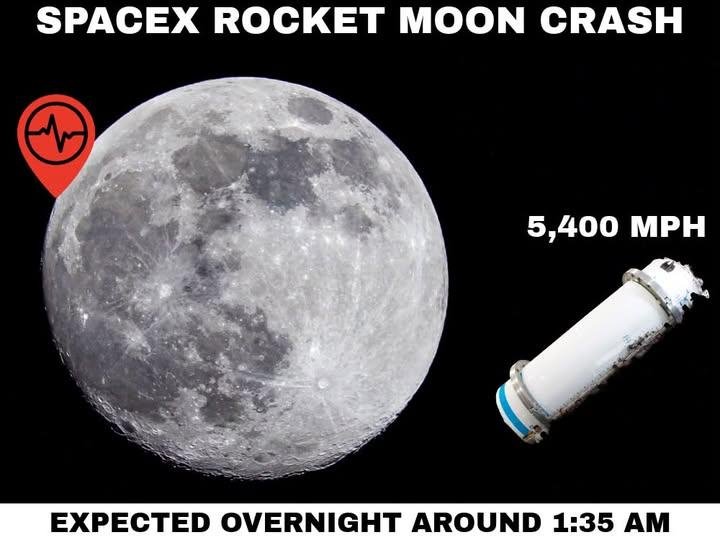
On August 5, 2026, a discarded upper stage of a SpaceX Falcon 9 rocket slammed into the lunar surface at roughly 5,400 miles per hour—seven times the speed of sound. The impact, which occurred near the Einstein Crater on the Moon’s sunlit western limb, was invisible to the naked eye and too faint for most telescopes to capture in real time. But for planetary scientists, it was anything but a non-event.
So, what happens if a SpaceX rocket crashes into the Moon? The answer is more fascinating—and more scientifically valuable—than you might expect. From carving a brand-new crater and sending a plume of dust 100 kilometers into the void to generating moonquakes that make the Moon “ring” like a bell, this accidental collision is teaching us lessons that could shape the future of lunar exploration.
Let’s break down exactly what occurs when human-made debris meets the lunar surface—and why scientists are calling this unexpected event a “gift.”
The Incident: What Actually Happened?
The story of this collision begins more than 18 months earlier. In January 2025, SpaceX launched a Falcon 9 rocket carrying two lunar landers as part of NASA’s Commercial Lunar Payload Services (CLPS) initiative. The rocket’s upper stage—roughly the size of a five-story building and weighing at least 4,000 kilograms (about 4.4 tons)—successfully fired the landers out of Earth’s orbit and onto a trajectory toward the Moon.
Once its job was complete, the spent stage was left drifting in a long, looping orbit that swung it out toward the Moon and back again. Over the following months, a combination of solar activity and gravitational forces from the Earth, Moon, and Sun gently nudged the derelict rocket onto a collision course.
Astronomers, including independent researcher Bill Gray, first identified the trajectory using publicly available data. NASA’s Center for Near Earth Object Studies later confirmed that the stage had a 100% chance of impacting the Moon. The impact occurred on August 5, 2026, at approximately 2:35 a.m. EDT (06:35 GMT), near the Einstein and Bell craters on the Moon’s sunlit side.
The Physics of a Lunar Impact
To understand what happens if a SpaceX rocket crashes into the Moon, we first need to appreciate the sheer energy involved.
Speed and Energy
The Falcon 9 upper stage struck the lunar surface at approximately 2.43 kilometers per second—about 5,400 mph or 8,690 km/h. At that velocity, the kinetic energy released upon impact was equivalent to roughly three tons of TNT.
For context, a meteoroid with the same energy hits the Moon about every six days. The Moon is constantly being bombarded by natural space debris. What makes this event remarkable is not its size but its predictability. Scientists knew the rocket’s exact mass, speed, and trajectory in advance—turning a random accident into a rare, controlled experiment.
Crater Formation
When a four-ton object traveling at supersonic speeds strikes a solid surface, something dramatic happens. NASA estimated the impact would create a crater about 60 feet wide and 12 feet deep—roughly the size of a small house. Other estimates suggest the crater could range from 20 to 30 meters (65 to 100 feet) in diameter.
The energy of the impact excavates lunar soil and rock, throwing material outward in what scientists call an “ejecta plume.” This plume can rise tens of kilometers above the surface before the ejected material falls back down, creating a secondary blanket of debris around the new crater.
What Happens When a Rocket Hits the Moon?
So, what happens if a SpaceX rocket crashes into the Moon in practical, physical terms? Let’s walk through the sequence of events.
The Explosion and Plume
Upon impact, the rocket stage doesn’t simply “land”—it vaporizes. The kinetic energy is converted almost instantly into heat, shock, and mechanical deformation. The rocket’s structure is obliterated, and a large portion of its mass is either melted, vaporized, or fragmented into tiny pieces scattered across the impact site.
A plume of dust and rock shoots upward from the impact point. Scientists predicted the central ejecta plume could rise as high as 60 miles (100 kilometers) above the lunar surface. The plume spreads sideways over time, creating a visible disturbance that, for a few minutes, alters the local appearance of the lunar surface.
Observatories in the Americas, including the Very Large Telescope in Chile, detected the plume’s chemical signature. Sodium gas—believed to originate from the lunar soil—and traces of lithium, possibly from the rocket stage itself, were identified in the plume’s spectra.
Moonquakes and Seismic Waves
The Moon lacks the thick atmosphere and oceans that absorb energy on Earth. When an impact occurs, the seismic waves travel through the lunar interior with remarkable efficiency.
As one scientist explained, “The seismic waves actually pass through the Moon faster, so the Moon really rings when these impacts happen”. This “ringing” effect provides scientists with a unique opportunity to study the Moon’s internal structure. By analyzing how seismic waves propagate, researchers can infer details about the composition and density of the lunar crust and mantle.
The New Crater
The most visible and lasting consequence is the new crater. The Falcon 9 upper stage carved a fresh scar into the lunar surface near the Einstein Crater—a feature located on the northwestern limb of the Moon, close to the terminator zone where lunar day and night meet.
The crater’s size—approximately 60 feet wide and 12 feet deep—is modest by lunar standards. The Moon is covered in craters of all sizes, from microscopic pits to massive basins hundreds of kilometers across. But this crater is unique: it’s the result of a known, human-made object with a precisely tracked trajectory.
Scientific Value: A Gift for Planetary Scientists
For researchers studying the Moon, this accidental collision is a rare and valuable opportunity. As the BBC’s science correspondent put it, “It is a dream moment for planetary scientists”.
Testing Impact Models
Because scientists knew the rocket’s exact size, speed, and point of impact in advance, this collision functions as a controlled experiment. Researchers can test their models of how impacts create craters, scatter material across the surface, and send tremors through the Moon’s interior.
These models are crucial for understanding not just the Moon, but all rocky bodies in the solar system. Every crater tells a story about the impact that created it—and accurate models help scientists read those stories more precisely.
Understanding Lunar Geology
The ejecta plume thrown up by the impact offers fresh clues about the Moon’s geology. Material from beneath the surface—normally buried under layers of regolith (lunar soil)—is suddenly exposed. By analyzing the composition of this ejected material, scientists can learn about the subsurface layers they wouldn’t otherwise be able to sample.
The detection of sodium gas in the plume, for example, provided new data about the chemical makeup of the lunar surface at that location.
Informing Future Missions
Perhaps most importantly, understanding impact dynamics has real practical value. NASA’s Artemis program aims to establish a sustained human presence on the Moon. Engineers need to know how far flying debris can travel during a landing or an impact, and how hard the ground might shake nearby.
As one researcher noted, understanding how impacts distribute rock and dust across the lunar surface will help engineers design safer spacecraft, landing sites, and future lunar habitats. Every impact—natural or artificial—provides data that makes future missions safer and more successful.
Historical Context: When Rockets Have Hit the Moon Before
The SpaceX Falcon 9 impact is far from the first time human-made objects have struck the lunar surface.
The Apollo Era
During the Apollo program, NASA deliberately crashed several Saturn V upper stages (called S-IVB stages) into the Moon. These controlled impacts were used to calibrate seismometers that astronauts had left on the surface. The vibrations generated by the impacts helped scientists study the Moon’s internal structure.
The Apollo S-IVB craters were substantially larger than the Falcon 9 crater—greater than 35 meters (about 38 yards) in diameter. They were also somewhat irregular in outline, unlike the more symmetrical craters created by natural impacts.
LCROSS (2009)
In 2009, NASA’s Lunar Crater Observation and Sensing Satellite (LCROSS) mission deliberately crashed a spent Centaur rocket stage into the permanently shadowed Cabeus crater near the lunar south pole. The purpose was to create a debris plume that could be analyzed for the presence of water ice and other chemicals in the lunar regolith. The mission successfully confirmed the presence of water on the Moon.
The 2022 Mystery Rocket
In March 2022, a spent rocket stage—initially thought to be a SpaceX Falcon 9 but later identified as a Chinese Long March 3C—crashed into the lunar far side. The impact created an unusual double crater: an eastern crater 18 meters in diameter superimposed on a western crater 16 meters in diameter.
This double crater was unexpected and suggested that the rocket body had large masses at each end. No other rocket body impacts on the Moon have created double craters, making this a unique feature in lunar impact history.
The Space Debris Question
While the scientific value of this impact is clear, the event also raises important questions about space debris.
A Growing Problem
Astronomer Matt Bothwell warned about the long-term effects of space debris, noting that “it could feasibly be, within a few decades, hard to get past Earth’s orbit because space is so crowded”. The Moon is now littered with roughly 3,000 human-made objects.
The Falcon 9 upper stage was not designed to crash into the Moon. It ended up on a collision course because of the unpredictable interplay of gravitational forces and solar radiation pressure. This highlights a fundamental challenge: as we launch more objects into space, tracking and managing them becomes increasingly difficult.
A Safer Alternative?
European Space Agency debris expert Holger Krag noted that the rocket stage crashing into the Moon is actually safer than the alternative—an uncontrolled reentry into Earth’s atmosphere. “Leaving it drifting around an orbit around the Sun does not provide assurance that it will not be captured again by Earth one day,” he explained.
In some cases, disposing of upper stages on the lunar surface is a technically accepted and safe method. Many operators choose controlled impacts because they provide predictable and trackable end-of-life outcomes.
However, as lunar exploration accelerates, the risk of accidental impacts and debris accumulation will only grow. The Falcon 9 impact serves as both a scientific opportunity and a cautionary tale.
Frequently Asked Questions (FAQs)
1. Did the SpaceX rocket crashing into the Moon pose any danger to Earth?
No. NASA and other space agencies confirmed that the impact posed no danger to Earth. The rocket stage was relatively small (about four tons), and the Moon is approximately 384,000 kilometers away. The impact was entirely localized to the lunar surface.
2. Could the impact be seen from Earth?
The impact itself was not visible to the naked eye. The flash it produced lasted only a fraction of a second and was too faint for amateur telescopes. However, powerful observatories in the Americas detected the plume of debris using specialized instruments. Some astronomers may have seen a dust plume stretching up to 100 kilometers that lasted for several minutes.
3. How big was the crater created by the SpaceX rocket?
NASA estimated the crater would be about 60 feet (18 meters) wide and 12 feet (4 meters) deep. Other estimates suggest it could range from 20 to 30 meters (65 to 100 feet) in diameter. The exact size will be confirmed once lunar orbiters capture detailed images of the impact site.
4. Why didn’t we see live images of the crash?
No spacecraft orbiting the Moon was in the right place at the right time to witness the impact live. South Korea’s Danuri orbiter passed near the crash site shortly beforehand, but its footage will only be released after researchers complete their analysis. NASA’s Lunar Reconnaissance Orbiter will pass over the site in the coming days to capture before-and-after images.
5. What scientific data can scientists gather from this impact?
The impact provides a rare opportunity to test models of crater formation, ejecta dynamics, and seismic wave propagation. Scientists can also study the composition of material ejected from beneath the surface, offering new insights into lunar geology. This data will help inform the design of safer landers and future lunar bases under NASA’s Artemis program.
6. How fast was the SpaceX rocket traveling when it hit the Moon?
The Falcon 9 upper stage struck the lunar surface at approximately 5,400 miles per hour (8,690 km/h), or about 2.43 kilometers per second. That’s nearly seven times the speed of sound.
7. Has a SpaceX rocket crashed into the Moon before?
No. While other rocket stages have hit the Moon—including Saturn V upper stages during the Apollo program and a Chinese rocket in 2022—this is the first confirmed impact involving a SpaceX Falcon 9 rocket. However, there was initial confusion in 2022 when a rocket stage was first thought to be a SpaceX Falcon 9 but was later identified as Chinese.
8. Will this impact affect future Moon missions?
The impact itself won’t directly affect future missions, but the data collected from it will. Understanding how impacts distribute debris and generate seismic waves will help engineers design safer landing sites and habitats. The event also highlights the growing challenge of space debris management as lunar exploration intensifies.
Conclusion
So, what happens if a SpaceX rocket crashes into the Moon? The answer is a remarkable convergence of physics, science, and unintended opportunity. A four-ton piece of human-made debris traveling at 5,400 miles per hour carves a new crater into the lunar surface, sends a plume of dust 100 kilometers into the void, and generates seismic waves that make the Moon “ring” like a bell.
But beyond the spectacle, this accidental collision is a scientific gift. It allows planetary scientists to test their models, refine their understanding of lunar geology, and gather data that will make future missions safer and more successful. It also serves as a reminder of the growing challenge of space debris—a problem that will only become more pressing as humanity’s presence in space expands.
The Moon has been absorbing impacts for billions of years. This one is different. It’s a reminder that even our accidents can teach us something profound about the universe—and about our place in it.
Key Takeaways
-
A discarded SpaceX Falcon 9 upper stage struck the Moon on August 5, 2026, at 5,400 mph, creating a new crater near the Einstein Crater and sending a plume of debris tens of kilometers into the lunar sky.
-
The impact posed no danger to Earth and was not visible to the naked eye, but powerful telescopes detected the plume’s chemical signature, including sodium and lithium.
-
Scientists view the collision as a “controlled experiment” because they knew the rocket’s exact mass, speed, and trajectory in advance, allowing them to test models of crater formation and ejecta dynamics.
-
The data collected will inform future lunar missions, helping engineers design safer landers, landing sites, and habitats under NASA’s Artemis program.
-
The event highlights the growing challenge of space debris, with the Moon now littered with roughly 3,000 human-made objects and the risk of accidental impacts increasing as lunar exploration accelerates.
-
NASA – Official statement on the Falcon 9 lunar impact and observation plans: https://www.nasa.gov/humans-in-space/commercial-space/nasa-will-attempt-to-observe-rocket-parts-lunar-impact/
-
BBC News – “SpaceX: What can scientists learn from a Falcon 9 rocket hitting the Moon?” – In-depth analysis of the scientific value of the impact
-
Space.com – “A SpaceX rocket just crashed into the moon. Now, the race is on to get a look at the impact site” – Coverage of the impact and observation efforts
-
NASA’s Lunar Reconnaissance Orbiter – Documentation of the 2022 double crater impact, providing historical context for artificial lunar impacts
-
The Guardian – “Spectral lines’ and a giant plume: what science saw when the SpaceX rocket hit the moon” – Details on the chemical detection from the impact plum