The Apple MacBook Pro 16-inch M3 Max

 Tech Review
 The Apple MacBook Pro 16-inch M3 Max
Launched in late 2023, the Apple MacBook Pro 16-inch M3 Max represents a meaningful leap forward in Apple’s laptop lineup, particularly for creative professionals and power users who demand the very best from their machines. From its groundbreaking silicon to its stunning display, this laptop makes a strong case for being the most capable MacBook Apple has ever shipped. But it comes at a price — literally — and understanding exactly what you’re getting is essential before committing to such a significant purchase.
The M3 Max Chip: A New Era of Performance
At the heart of this machine lies the M3 Max chip, and it’s impossible to talk about this laptop without spending real time on the silicon that defines it. Built on a 3-nanometer architecture, the M3 Max represents Apple’s most advanced chip engineering to date. Configurations scale up to a 16-core CPU and a 40-core GPU, delivering processing and graphics power that, until recently, you would have needed a desktop workstation to match.
What makes the M3 Max particularly exciting isn’t just raw core counts — it’s the qualitative improvements baked into that architecture. The chip introduces hardware-accelerated ray tracing and mesh shading, two technologies that have enormous implications for both professional creative work and gaming. Ray tracing, in particular, enables far more realistic lighting, shadows, and reflections in 3D environments, which benefits everyone from architects rendering building visualizations to motion graphics artists producing broadcast content.
In benchmark testing, the MacBook Pro 16-inch M3 Max doesn’t just outperform its predecessors — it competes directly with desktop-grade Apple hardware, including the Mac Studio equipped with the M2 Ultra chip. That’s a remarkable achievement for a laptop. In graphics-intensive workflows, demanding applications that once required a powerful desktop or an expensive external GPU enclosure now run smoothly and efficiently on this portable machine.
Design: Familiar, Refined, and Built to Last
Apple made a deliberate choice not to reinvent the MacBook Pro’s exterior with this generation, and for most users, that’s the right call. The unibody aluminum clamshell design that has defined MacBook Pro for years remains intact — and for good reason. It’s rigid, premium, and immediately communicates quality the moment you pick it up. The chassis feels solid without being unnecessarily heavy, striking a careful balance between durability and portability for a 16-inch machine.
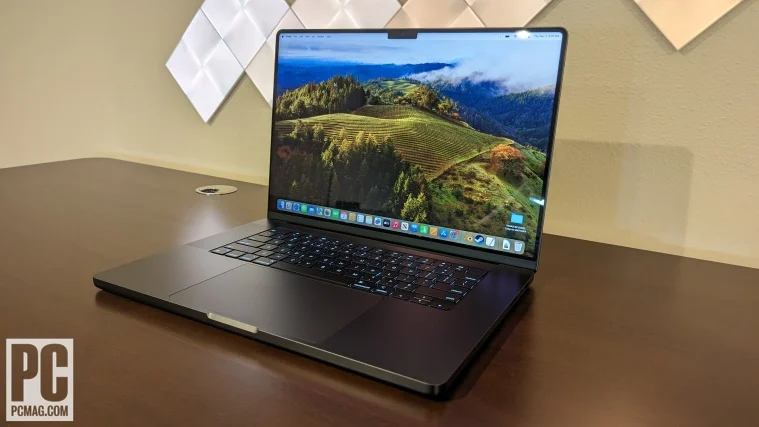
The one notable design addition is the new Space Black color option. While it may sound like a minor cosmetic update, Space Black is a genuinely attractive finish that gives the MacBook Pro a more refined, sophisticated look compared to the standard Space Gray. It’s a small but welcome change for professionals who care about the aesthetics of the tools they use every day.
The port selection remains one of the MacBook Pro’s practical advantages over many competing laptops. You get multiple Thunderbolt 4 ports, HDMI, an SD card slot, and MagSafe charging — a combination that dramatically reduces dependence on dongles and adapters in real-world professional environments.
The Display: One of the Best Screens on Any Laptop
Apple’s Liquid Retina XDR display continues to set the standard for laptop screens in the professional space. The 16-inch Mini-LED panel delivers exceptional brightness, deep blacks, and color accuracy that rivals dedicated studio monitors in many contexts. The 120Hz ProMotion refresh rate ensures silky smooth scrolling, animation, and video playback, adapting dynamically to the content being displayed to preserve battery life when high refresh rates aren’t needed.
For professionals working in video production, color grading, photography, or graphic design, the display’s support for HDR content is a significant advantage. Being able to accurately preview HDR video or edit high-dynamic-range photos directly on your laptop’s built-in screen — without needing an external reference monitor — is genuinely useful in many professional contexts.
The integrated 1080p webcam is a practical upgrade that acknowledges how central video conferencing has become to modern professional life. Image quality is noticeably better than the cameras found on many competing laptops, making it more than adequate for client calls, remote collaboration, and virtual presentations. The one missing feature worth noting is Face ID — the MacBook Pro still relies on Touch ID in the keyboard, which works well but feels like an omission given how seamlessly Face ID works on iPhones and iPads.
Battery Life: Power Without the Power Cable
One of the most counterintuitive things about the MacBook Pro 16-inch M3 Max is that, despite housing one of the most powerful chips ever placed in a laptop, it delivers impressive battery life. Apple’s tight integration between hardware and software means the M3 Max is exceptionally efficient, drawing only the power it needs for any given task rather than running at full tilt constantly.
For professionals who work away from a desk — whether in client meetings, on location shoots, or simply moving around an office — this battery longevity is genuinely valuable. The ability to work through long, demanding sessions without constantly hunting for a power outlet makes the MacBook Pro a more practical daily tool than its raw specifications might suggest.
Gaming: A Serious New Contender
Macs have historically been overlooked as gaming machines, largely because the game library available on macOS paled in comparison to Windows. The M3 Max, with its hardware-accelerated ray tracing and powerful 40-core GPU, meaningfully changes what’s possible on a Mac from a pure performance standpoint. Apple has been actively cultivating partnerships with major game studios to bring more titles to the platform, and the results are beginning to show.
The MacBook Pro 16-inch M3 Max won’t replace a dedicated gaming PC for hardcore gamers who prioritize library breadth above all else, but it does challenge the long-held assumption that Macs simply can’t handle serious gaming. For creative professionals who also enjoy gaming, having a single machine capable of both high-end creative work and competent gaming performance is a compelling proposition.
Who Should Buy the MacBook Pro 16-inch M3 Max?
The honest answer is that this laptop is a niche product designed for a specific type of user — and there’s nothing wrong with that. Its premium price point means it won’t make sense for everyone, and Apple isn’t pretending otherwise. The MacBook Pro 16-inch M3 Max is best suited for:
- Video editors and motion graphics artists who work with large, high-resolution files and need fast render times.
- 3D artists and architects who rely on GPU-accelerated rendering and can benefit directly from ray tracing hardware acceleration.
- Musicians and audio producers running complex projects with high track counts and demanding plugins.
- Software developers compiling large codebases or running multiple virtual machines simultaneously.
- Power users who want the absolute best portable Mac available and will genuinely push it to its limits.
If your work fits into one of these categories and you’ve felt constrained by your current laptop, the M3 Max MacBook Pro will likely feel like a transformative upgrade. If your work is lighter — web browsing, document editing, occasional photo work — the standard MacBook Pro with the base M3 chip, or even a MacBook Air, will serve you just as well at a significantly lower cost.
Final Verdict
The Apple MacBook Pro 16-inch M3 Max is, without question, one of the most capable laptops ever made. Its 3nm M3 Max chip delivers desktop-class performance in a portable form factor, the Liquid Retina XDR display remains among the finest screens available on any laptop, and the battery life defies expectations given the raw power on offer. The addition of Space Black adds a touch of premium flair, and the improved gaming capabilities signal that Apple is serious about making Macs relevant in that space.
Its high price positions it firmly as a professional tool rather than a mainstream laptop, but for the right user — the creative professional, the developer, the power user who demands the best — it delivers unmatched performance and quality. Few laptops can match what this machine offers, and none of them run macOS.