
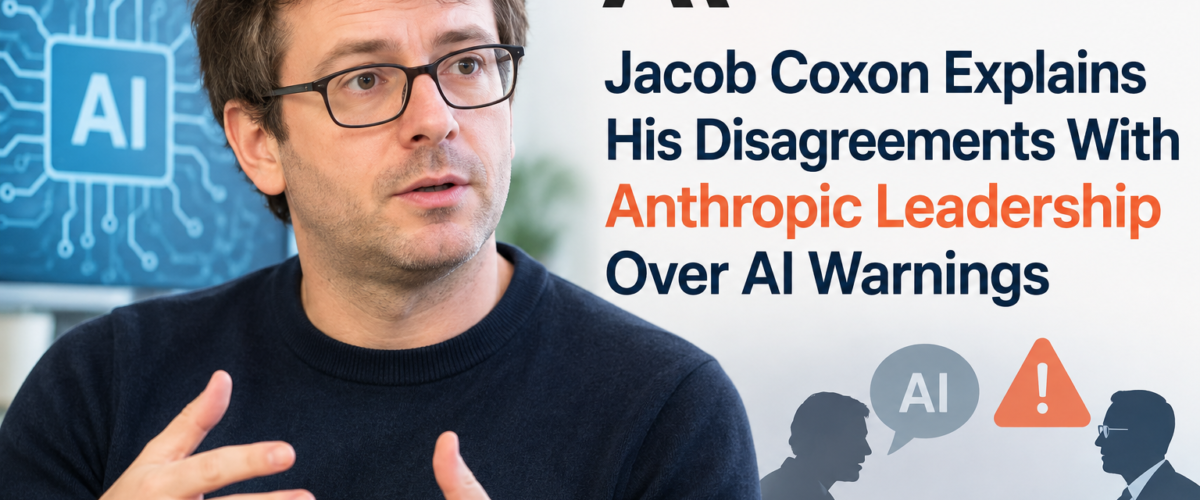
A week after his resignation post went viral, the former Anthropic researcher behind it sat down for a live X AMA and got considerably more specific about exactly what he thinks his former employer got wrong — not just that AI is risky in the abstract, but a direct accusation about who actually started the race he’s now warning about.
What Jacob Coxon Actually Said This Time
Speaking during a Tuesday AMA on X, Jacob Coxon detailed his disagreements with Anthropic leadership directly, according to Business Insider’s reporting on the exchange. His central claim: Anthropic itself played a leading role in triggering the current race toward recursive self-improvement, driven by a belief inside the company that this race was going to happen regardless of who started it first.
The Backstory: How This Started
Coxon, a 27-year-old British researcher, published his original resignation announcement from a park bench in San Francisco’s Alamo Square on September 8, spending three years working on pretraining research at both OpenAI and Anthropic before leaving. His post argued that neither company was acting responsibly, framing the current pace of development as a race toward self-improving superintelligence that was gambling with genuinely high stakes, with no expectation the message would spread the way it did.
Why This Follow-Up Matters More Than the Original Post
A viral resignation announcement is one thing — a former insider going on the record with a specific, named accusation about which company actually initiated a dangerous dynamic is a meaningfully more serious claim. Coxon’s argument isn’t simply that AI development is moving too fast in general; it’s that Anthropic specifically treated the race as inevitable and acted on that belief in a way that helped bring the race into existence, rather than the company being a reluctant participant responding to competitors.
How Anthropic Has Responded
Anthropic has not stayed silent on this. According to CBS News’ coverage of the company’s response, a company spokesperson said Anthropic has “always been transparent” that AI carries both major benefits and serious risks, and pointed to the company’s own safety measures as among the strongest in the industry. That statement addresses the general safety question, but doesn’t directly rebut Coxon’s more specific claim about who set the current competitive dynamic in motion.
Coxon Isn’t Alone — Other Researchers Are Saying Similar Things
Evan Hubinger, who leads a department at Anthropic specifically focused on ensuring AI behaves as intended, has separately said he genuinely believes AI could pose an extinction-level risk. At OpenAI, researcher Marcus Williams has gone further, putting a specific number on it — roughly 70% likelihood of serious harm within a few years absent coordinated regulation or a coordinated slowdown between labs. Having researchers from both major labs converge on similar public concerns, independently, adds real weight beyond one individual’s account.
What Critics Are Saying
Not everyone is treating Coxon’s warnings as authoritative. Hugging Face CEO Clem Delangue publicly dismissed his extinction-risk concerns, comparing him to an air-conditioning technician commenting on climate change — despite Coxon’s three years of direct pretraining experience at both labs. Coxon has also faced pointed questions about his relatively short tenure at Anthropic specifically, which he’s addressed directly rather than avoiding during his public appearances.
What Coxon Is Actually Proposing
Coxon’s stated position isn’t that a single company should unilaterally stop while everyone else continues — he’s specifically argued for coordinated limits between American AI labs, and eventually broader international agreements, particularly if AI systems begin meaningfully accelerating their own development. This is a genuinely harder problem than it sounds, since countries and companies retain real financial, scientific, and national-security incentives to keep building regardless of coordination efforts. It connects to the broader debate we’ve covered in how worried people should actually be about AI’s trajectory, where genuine expert disagreement exists about both timeline and severity, even among people who broadly share Coxon’s underlying concern.

