
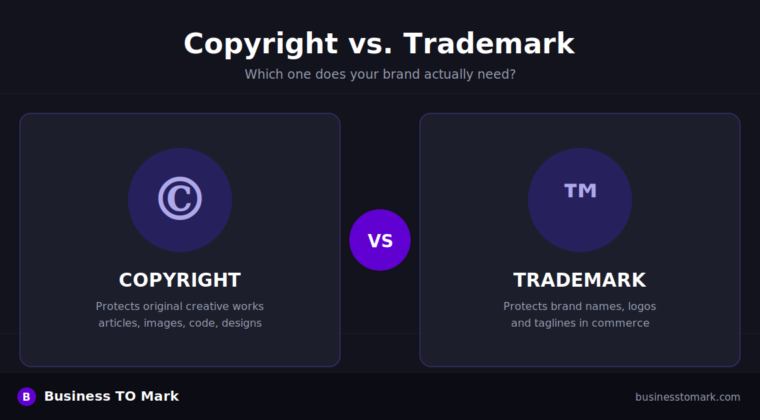
If your business creates original written, visual, or audio content, you need copyright protection, which is automatic the moment you create the work. If your business has a name, logo, or slogan customers use to identify you in the marketplace, you need trademark protection, which requires active registration to be enforceable. Most growing brands eventually need both, but they protect entirely different things.
Business owners frequently use these two terms interchangeably, which leads to real legal exposure — registering the wrong type of protection, or assuming you’re covered when you’re not, can leave your brand’s most valuable assets unprotected.
In this article
The Core Difference
Copyright protects original creative works — writing, photography, video, music, software code, and website design elements — the moment they’re fixed in a tangible form. You don’t have to register it for it to exist, though registration strengthens your ability to enforce it in court.
 Also readWhat Does Squawk 7700 Mean on a Flight? I Followed 5 Real 7700 Alerts to Find Out
Trademark protects brand identifiers — your business name, logo, tagline, and sometimes even a distinctive color scheme or sound — that customers use to distinguish you from competitors. Trademark rights come from actual use in commerce, but formal registration provides significantly stronger nationwide protection.
Side-by-Side Comparison
| Factor | Copyright | Trademark |
|---|---|---|
| What it protects | Original creative works | Brand names, logos, slogans |
| When protection starts | Automatically upon creation | Upon use in commerce (stronger with registration) |
| Registration required? | No, but recommended for enforcement | Not legally required, but strongly recommended |
| Duration | Life of author + 70 years (typically) | Indefinite, as long as it’s actively used and renewed |
| Governing body (US) | U.S. Copyright Office | U.S. Patent and Trademark Office (USPTO) |
| Example | Your website’s blog content, product photos | Your business name and logo |
Step-by-Step: Deciding What Your Brand Needs
- List your creative assets — blog posts, product images, video content, custom illustrations, software code. These need copyright consideration.
- List your brand identifiers — business name, logo, tagline, packaging design. These need trademark consideration.
- Check for existing conflicts before committing to a brand name — search the USPTO’s trademark database and general web/social media presence to avoid infringing on an existing mark.
- Register your copyright for your most valuable creative works, especially anything central to your business model (software, a signature course, branded design assets).
- File a trademark application for your business name and logo once you’re actively using them in commerce, ideally before significant marketing investment.
- Use proper notice — the © symbol for copyrighted works and the ™ symbol for unregistered trademarks (® is reserved for federally registered marks only).
- Monitor for infringement periodically — set a recurring reminder to search for unauthorized use of your name, logo, or key content.
When You Need Copyright Protection
- You publish original blog content, e-books, or courses.
- You produce custom photography, videos, or graphic designs.
- You develop proprietary software or app code.
- You create original marketing copy, jingles, or audio content.
When You Need Trademark Protection
- You have a distinctive business name customers associate with your reputation.
- You’ve designed a logo that appears across your website, packaging, and marketing.
- You use a tagline or slogan consistently as part of your brand identity.
- You’re expanding into new markets or products under the same brand name.
Common Legal Mistakes Business Owners Make
- Assuming a business name registration or domain purchase equals trademark protection — it does not; these are separate legal systems entirely.
- Using someone else’s copyrighted images from a Google search without a proper license, believing “it’s just for my website.”
- Delaying trademark registration until after a competitor has already built recognition around a similar name.
- Forgetting international protection — copyright and trademark rights are largely territorial, so global brands need country-specific registrations or international treaties (like the Madrid Protocol for trademarks).
Enforcement: What Happens If You’re Infringed Upon
- For copyright infringement: a registered copyright allows you to file a lawsuit and pursue statutory damages; an unregistered copyright still exists but limits your remedies.
- For trademark infringement: a registered trademark gives you nationwide legal presumption of ownership, making cease-and-desist letters and litigation significantly stronger.
- In both cases, document the infringement (screenshots, dates) immediately and consult an attorney before taking public action.
Do You Need Both? (Usually, Yes)
A typical growing brand needs copyright for its content and creative assets, and trademark for its name and logo — these work together, not as alternatives. A software company, for example, copyrights its code and trademarks its product name; a content creator copyrights their videos and trademarks their channel brand.
Final Takeaway
Copyright and trademark solve different legal problems: one protects what you create, the other protects how customers recognize you. Map your business assets against both categories, prioritize registering whichever protects your most valuable and most vulnerable asset first, and treat this as an ongoing part of brand management — not a one-time checkbox.