Last updated: October 22, 2026 · 8 min read
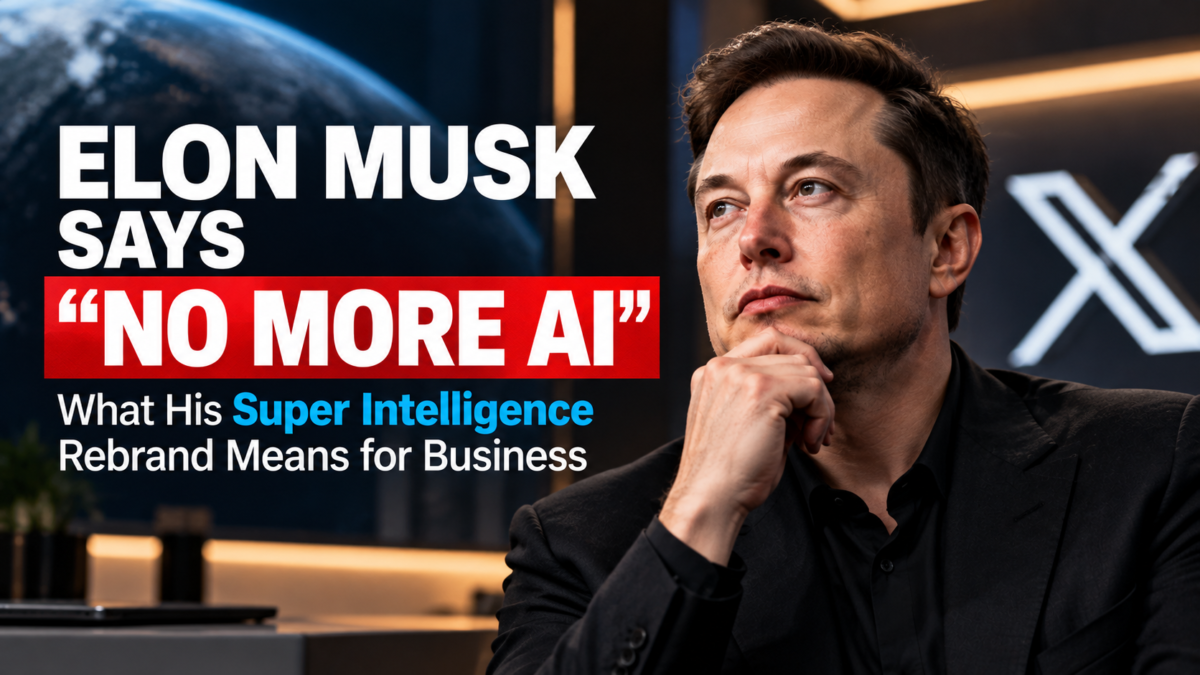
Elon Musk has a habit of moving markets and headlines with a few words on X, and October 2026 is no exception. In a handful of short posts, the SpaceX chief declared that the era of calling the technology “AI” is over, confirmed his AI division would be renamed, and then backed it up with huge claims about computing power and a surprising promise to give shares to children.
For business owners, marketers, and investors, these posts are more than internet noise. They show where one of the most influential tech companies on the planet believes the industry is heading, and how fast the vocabulary around it is changing.
 Also readTesla Q3 2026 Earnings Preview: 6 Things to Watch Today
In this guide, we break down what Musk actually posted, why the new terminology matters, what the numbers behind his claims look like, and what practical lessons your company can take from it.

In this article
- What Elon Musk Actually Posted
- Why the Name Change Matters More Than It Seems
- From xAI to SpaceXSI: A Quick Corporate Timeline
- The Computing Power Behind the Big Claims
- Racing the Competition
- A Share of SpaceX for Every Kid
- The “One-Shotted” Warning
- What Business Owners Should Take Away
- Frequently Asked Questions
- Is It Just Branding?
- Conclusion
What Elon Musk Actually Posted
The “No More AI” Post
On October 4, 2026, Musk wrote on X that there should be “no more AI” and that “SI” is better. SI stands for Super Intelligence. When a user asked whether SpaceXAI could be renamed SpaceXSI, he answered, “Yes, we will make that change,” and added that SpaceX is a super intelligence company.
The details matter here. Reuters reporting carried by Khaleej Times notes that Musk gave no timeline and no extra explanation, and the SpaceXAI accounts had not been changed at the time. In other words, the direction is confirmed, but the date is not.
Where the “Super Intelligence” Push Came From
Musk did not invent this wording on his own. The term has been building momentum in Washington for weeks:
- September 22: In a speech at the UN General Assembly, President Trump said official US documents should use “super” instead of “artificial.”
- September 29: An executive order titled “Inaugurating the Era of Super Intelligence” told federal agencies to use “Super Intelligence” and “SI” in official communications where the law allows. According to Drive Tesla Canada, it also asks the White House science adviser to propose a federal definition within 60 days.
- October 4: A new “Super Intelligence Force” was announced to oversee AI policy, as Cybernews reported.
That context explains the timing. Musk is aligning his brand with the language of the government, and that is a smart move for a company that depends on federal contracts and launch approvals.
Why the Name Change Matters More Than It Seems
At first glance, swapping one letter pair for another looks like pure branding. But language shapes how people think about technology, how regulators write rules, and how investors price risk.
- Perception: “AI” now covers everything from photo filters to customer-service bots. “Super Intelligence” signals something far more powerful and far more consequential.
- Regulation: When a government adopts a term, it tends to appear in laws, procurement documents, and policy debates. A new official vocabulary can quietly change what gets regulated and how.
- Investment: Companies that say they are building super intelligence are asking for a different valuation story than companies selling software features.
The idea is not new for Musk. He has long been fascinated by Nick Bostrom’s 2014 book Superintelligence, which warned that machines far smarter than humans could become very hard to control. Musk has often said such systems could be more dangerous than nuclear weapons, even as he builds one of the largest AI operations on earth. That contradiction is part of what makes him such a polarizing figure.
From xAI to SpaceXSI: A Quick Corporate Timeline
To see why another rename is plausible, it helps to look at how quickly Musk’s AI business has changed shape.
- March 2023: Musk founded xAI and introduced its chatbot, Grok, later that year.
- February 2, 2026: SpaceX completed its acquisition of xAI. Reports valued xAI at roughly $250 billion and the combined company at about $1.25 trillion.
- May 2026: Musk said xAI would stop existing as a separate company, with Grok and X becoming the AI division of SpaceX.
- June 12, 2026: SpaceX went public, raising about $86 billion at $135 per share, according to Implicator.
- July 2026: The division was rebranded as SpaceXAI.
- October 2026: Musk confirmed another rename, this time to SpaceXSI.
Three names in under a year is unusual, even for Musk. Still, the strategy is simple: fold AI into the SpaceX story and present the whole group as one giant technology company. It also helps to know that SpaceX is now publicly traded, so every post from its CEO carries more weight with shareholders than it did a year ago.
One open question remains. It is not yet clear whether SpaceXSI will be a formal legal name change or only a branding update, a point also raised by Not a Tesla App.
The Computing Power Behind the Big Claims
Words on X are cheap. Computing hardware is not. That is why Musk’s remarks on SpaceX’s third-quarter 2026 earnings call, held on October 20, drew so much attention.
The Numbers Musk Shared
- SpaceX had 1.7 gigawatts of nameplate compute on September 30, up from 1.4 gigawatts on June 30.
- The company expects 2.5 to 3 gigawatts by the end of 2026.
- Musk said he would be surprised if SpaceX brought on less than 13 gigawatts by the end of 2027, which means adding roughly 10 gigawatts in about fifteen months.
- SpaceX is installing around 200,000 Nvidia GB300 GPUs every month for the rest of 2026, with a cluster of 440,000 GPUs expected by mid-2027, as Crypto Briefing reported.
- Musk tied the buildout to a possible $500 billion to $1 trillion in annual recurring revenue by the end of 2027, per 24/7 Wall St.
A Reality Check on the Targets
These are ambitious goals, and Musk’s timelines have a mixed track record. Building power plants, data centers, and cooling systems at this pace is a massive engineering and supply-chain challenge. Even Musk tempered the plan on the call, saying he does not expect everything to go right.
The money involved is also huge. Stocktwits reports SpaceX spent $19.6 billion on capital projects in the third quarter, and the same coverage notes that ARK’s own forecast for 2027 sits below 8 gigawatts, far under Musk’s figure. That gap is a useful reminder that a target is not a result.
Even so, the direction is clear. The race is now about who can secure the most electricity and chips, not only who has the cleverest algorithm. For a deeper look at how this connects to Musk’s other company, see our Tesla Q3 2026 earnings preview.
SpaceX Now Reports “Super Intelligence” as Its Own Business
The rename is not only cosmetic. According to Invezz, the quarter showed $7.6 billion in revenue from the Super Intelligence business, up 830% from a year earlier and more than half of total sales. If those figures hold, the AI unit has become the main engine of the company, which helps explain why Musk wants the label to carry weight.
Racing the Competition
Back in September, Musk said he was cautiously optimistic that SpaceX would have a model at the level of Anthropic’s Fable or OpenAI’s GPT-6 within two to three months. He argued that his AI efforts are only three years old, compared with six years for Anthropic and ten for OpenAI, and predicted SpaceX could reach the front of the pack in about six months, as Forbes reported.
Fast growth in compute makes that claim easier to believe, but models are judged by results, not by gigawatts. Watch for independent benchmarks before taking any of these timelines at face value. If you want more on how the big labs compare, browse our AI Technology section.
A Share of SpaceX for Every Kid
The most surprising post of the month came on October 19. Musk wrote that next year he would give one of his SpaceX shares to every child in America, and that it would be the first of many such gifts.
The post arrived one day after Anthropic announced it would set aside five percent of its shares for a public benefit fund meant to address the labor-market effects of AI. Musk replied that companies should hand shares directly to the public instead, according to NBC News.
Why This Could Be a Smart Reputation Move
Public trust in AI is under strain. Many people worry that a few companies will capture most of the gains while workers face disruption. Offering a financial stake is one way to answer that worry, because ownership gives people a reason to root for these companies rather than resist them.
What Is Still Missing
Details are thin. How the shares would be distributed, how many children would be covered, and which legal structure would hold them have not been explained. Until those answers arrive, treat the pledge as an intention rather than a finished program.
The “One-Shotted” Warning
On the same day, Musk also posted a more sobering thought. He suggested a future super intelligent system could be so persuasive that even he might be “one-shotted” by it, meaning convinced by a single well-crafted message. Coverage noted that no such capability has been demonstrated so far.
The comment matters for business because persuasion is the foundation of marketing and sales. If machines become better at changing minds than people, companies will face new questions about disclosure, consent, and fair competition. Marketers who want to stay ahead can start with our guide hub on digital marketing.
What Business Owners Should Take Away
You do not need to run a billion-dollar company to learn something from this news cycle. Here are five practical lessons.
- Watch the vocabulary. When governments and major companies change the words they use, funding, rules, and customer expectations usually follow. Expect “super intelligence” to appear more often in policy papers, grant language, and product pitches.
- Remember that infrastructure is the real moat. The biggest players are spending on power and chips at a staggering scale. Smaller businesses should focus on using available tools well rather than competing on raw capability.
- Plan for trust. Public skepticism is rising. Brands that are open about how they use automation will stand out from those that hide it.
- Verify before you act. Founder predictions, including timelines and benchmarks, are not guarantees. Base decisions on tested results, and treat market commentary as information, not financial advice.
- Stay informed. The pace of change is high, and a single post can shift the conversation overnight. Follow our business coverage and tech reviews to keep up.
Frequently Asked Questions
What does SpaceXSI stand for?
SpaceXSI is the planned new name for SpaceXAI. “SI” stands for Super Intelligence, so the name means SpaceX Super Intelligence.
Has SpaceXAI officially been renamed yet?
Musk confirmed the change on X, but no formal date or legal details have been announced. At the time of the early reports, the official SpaceXAI accounts had not been updated.
Why is “super intelligence” replacing “AI”?
The push follows President Trump’s UN speech and a September 29 executive order directing federal agencies to use “Super Intelligence” and “SI” in official communications where the law allows.
Is the 13 gigawatt target realistic?
It is possible but extremely demanding. It requires adding roughly 10 gigawatts in about fifteen months, and some analysts, including ARK, forecast much lower figures. Treat it as a goal, not a guarantee.
Is It Just Branding?
Skeptics will say a name change costs almost nothing and proves nothing. They have a point. Renaming a division does not make a model smarter, and bold claims on social media are not shipped products.
At the same time, branding is rarely meaningless. It tells employees what to build, tells investors what story to believe, and tells competitors what ground a company intends to claim. In this case, the new label also lines up with federal language, which could give SpaceXSI a smoother path in government conversations.
Conclusion
Elon Musk’s latest posts reveal a company that wants to be seen not as a chatbot maker but as a builder of super intelligence, backed by massive computing investment and a willingness to share ownership with the public. Some of it is marketing, some of it is real engineering ambition, and some of it remains unproven.
The sensible approach for readers is to take the signals seriously while waiting for results. The language of the technology is changing, and with it the expectations of customers, regulators, and investors. Businesses that pay attention now will be better prepared for whatever name, and whatever capability, comes next.