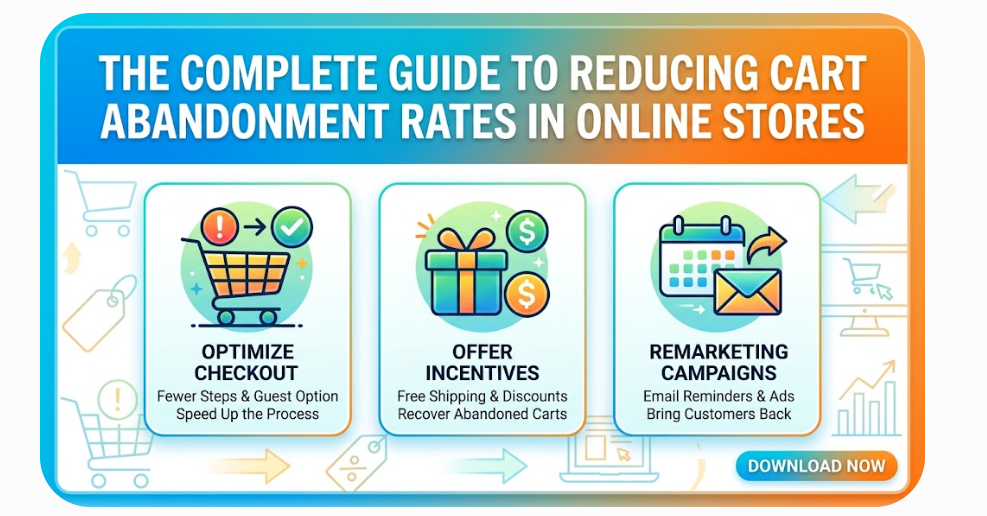
The fastest way to reduce cart abandonment is to remove friction at three specific points: unexpected costs at checkout, a forced account creation step, and a checkout process that takes more than three steps. Fix those three, and most stores see abandonment drop within weeks. The rest of this guide breaks down exactly how.
Cart abandonment isn’t a mystery metric — it’s a direct signal that your checkout experience is asking customers to do more work, spend more money, or wait longer than they expected when they added an item to their cart. Industry research consistently shows average cart abandonment rates sit around 70%, meaning for every 10 shoppers who start checkout, roughly 7 leave without buying.
In this article
Why Shoppers Actually Abandon Carts
- Unexpected extra costs — shipping, taxes, or fees revealed only at the final step.
- Mandatory account creation — shoppers wanting a fast guest checkout get blocked.
- Complicated or long checkout process — too many form fields or pages.
- Lack of trust signals — no visible security badges, unclear return policy.
- Limited payment options — no digital wallets like Apple Pay or PayPal.
- Slow page load times — every extra second at checkout costs conversions.
- Just browsing/comparison shopping — some abandonment is unavoidable and healthy.
Diagnosing Where You’re Losing Customers
| Checkout Stage | Common Drop-Off Cause | Quick Fix |
|---|---|---|
| Cart page | Shipping cost surprise | Show estimated shipping early |
| Login/Account | Forced registration | Enable guest checkout |
| Shipping info | Too many form fields | Auto-fill + address lookup |
| Payment | Limited payment methods | Add digital wallets |
| Order review | Trust concerns | Add security badges, reviews |
| Confirmation | Slow processing | Optimize server response time |
Step-by-Step Action Plan to Fix Cart Abandonment
- Audit your checkout flow yourself. Go through the entire purchase process as a customer would, on both desktop and mobile, and time each step.
- Display total costs upfront, including estimated shipping and taxes, ideally on the product or cart page — not just at final checkout.
- Enable guest checkout as the default option, with account creation offered as a post-purchase upsell, not a gate.
- Reduce form fields to only what’s essential; use address auto-complete APIs to speed data entry.
- Add multiple payment options, including one-click wallets like Apple Pay, Google Pay, and PayPal Express.
- Show progress indicators (e.g., “Step 2 of 3”) so customers know how much is left.
- Add trust badges and a visible refund/return policy near the payment button.
- Send abandoned cart recovery emails within 1 hour, 24 hours, and 72 hours of abandonment, each with a slightly stronger incentive.
- Test page speed using tools like Google PageSpeed Insights and fix anything scoring below 80 on mobile.
- A/B test one checkout element at a time — button color, field order, or copy — to isolate what actually moves the needle.
Recovery Email Sequence That Works
- Email 1 (1 hour later): A simple, friendly reminder with product images and a direct “Complete Your Order” button — no discount yet.
- Email 2 (24 hours later): Address common objections (free returns, secure checkout, customer reviews) and reinforce urgency if stock is limited.
- Email 3 (72 hours later): Offer a small, time-limited incentive (free shipping or a modest discount) to close the sale.
Advanced Tactics for Established Stores
- Exit-intent popups that trigger a discount or free-shipping offer the moment a user’s cursor moves toward closing the tab.
- Retargeting ads on social platforms showing the exact products left in the cart.
- SMS cart recovery for stores with opted-in phone numbers, which often sees higher open rates than email.
- Live chat at checkout to answer last-minute questions before hesitation turns into abandonment.
Metrics to Track Monthly
- Cart abandonment rate = (Carts created − Completed purchases) ÷ Carts created × 100
- Checkout abandonment rate (a narrower, more actionable metric measuring drop-off after checkout has started)
- Recovery email conversion rate
- Average order value of recovered vs. first-time orders
Common Mistakes That Undo Your Progress
- Over-discounting in every recovery email, training customers to always wait for a coupon.
- Ignoring mobile checkout separately — mobile abandonment rates are typically higher than desktop and need their own optimization pass.
- Adding too many upsells at checkout, which reintroduces the friction you just removed.
- Not testing on real devices — emulators don’t always reflect real load times or touch-target issues.
Final Takeaway
Reducing cart abandonment isn’t about one dramatic redesign — it’s about systematically removing small frictions that compound into lost revenue. Start with cost transparency and guest checkout, since those two changes alone typically produce the fastest measurable improvement, then layer in recovery emails and payment flexibility as you scale.