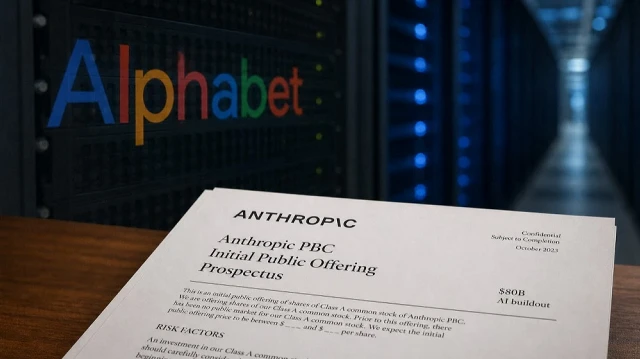
In a bold step that underscores the intense competition in artificial intelligence, Alphabet Inc., the parent company of Google, announced plans to raise up to $80 billion through equity offerings. This move, one of the largest equity raises in U.S. corporate history, highlights the enormous capital requirements for building next-generation AI infrastructure.
Alphabet Raising $80 Billion for AI Infrastructure is not just about funding data centers and chips—it signals confidence in explosive long-term demand for AI services while addressing immediate capacity constraints.
In this article
- The Announcement: Details of Alphabet’s $80 Billion Capital Raise
- Why Alphabet Needs $80 Billion: The AI Infrastructure Boom
- Breaking Down the Use of Funds
- Impact on Investors: Opportunities and Risks
- How This Fits into the Broader AI Race
- What Investors Should Watch Next
- The Role of Berkshire Hathaway’s Investment
- Future Outlook: AI Infrastructure as a Multi-Year Megatrend
- Conclusion
The Announcement: Details of Alphabet’s $80 Billion Capital Raise
On June 1, 2026, Alphabet revealed a multi-part equity offering totaling $80 billion. The structure includes:
 Also readBad Credit, Past Defaults, or Perfect Credit: How Fundivi Funds Businesses Across the Entire Credit Spectrum
- $10 billion private placement to Berkshire Hathaway.
- $30 billion in underwritten public offerings of Class A common stock and mandatory convertible preferred stock.
- $40 billion through an at-the-market (ATM) share sale program starting in Q3 2026.
Proceeds will fund “general corporate purposes, including capital expenditures to scale AI infrastructure and global compute.” This comes as Alphabet has already raised its 2026 capital expenditure (capex) guidance to $180–$190 billion.
The involvement of Warren Buffett’s Berkshire Hathaway adds significant credibility. Berkshire is purchasing $5 billion in Class A shares and $5 billion in Class C shares at a slight discount to market prices, representing a strong endorsement of Alphabet’s strategy.
Why Alphabet Needs $80 Billion: The AI Infrastructure Boom
The AI landscape has shifted from experimentation to large-scale deployment. Demand for compute power—driven by training and inference of large language models, enterprise AI tools, and consumer applications—has outstripped supply.
Key drivers include:
- Surging Google Cloud demand: Cloud revenue grew nearly 48% year-over-year in recent quarters, with a massive backlog of contracted but undelivered services.
- Gemini and AI product expansion: Integrating advanced AI across Search, YouTube, Android, and enterprise tools requires vast computational resources.
- Custom AI hardware: Alphabet continues investing in Tensor Processing Units (TPUs) and other specialized chips to reduce reliance on third-party suppliers like NVIDIA.
- Data center and energy constraints: Building and powering hyperscale facilities involves long lead times for land, power, and supply chain components.
Alphabet Raising $80 Billion for AI Infrastructure directly tackles these bottlenecks. Without sufficient capacity, the company risks losing market share to competitors like Microsoft, Amazon, and emerging AI-native firms.
Breaking Down the Use of Funds
The bulk of the capital will support:
- Data Center Expansion — New facilities and upgrades to existing ones worldwide.
- AI Compute Hardware — Servers, networking equipment, and custom chips (roughly 60% of recent capex has gone to servers).
- Energy Infrastructure — Securing power sources, including renewable and traditional, to support energy-intensive AI workloads.
- Global Compute Capacity — Enhancing cloud regions to serve growing enterprise and consumer demand.
- R&D and Strategic Investments — Continued development through Google DeepMind and other bets.
This infrastructure buildout positions Alphabet to capture a larger share of the projected multi-trillion-dollar AI market.
Impact on Investors: Opportunities and Risks
For investors, Alphabet Raising $80 Billion for AI Infrastructure presents a mixed but predominantly positive signal.
Potential Benefits
- Long-term Growth: Stronger AI capabilities could accelerate revenue in Google Cloud (a high-margin business) and enhance Google’s core advertising ecosystem through better AI-driven features.
- Competitive Moat: Heavy investment in proprietary infrastructure reduces dependency on external chip suppliers and strengthens bargaining power.
- Berkshire Validation: Buffett’s involvement reassures investors about the prudence of the strategy.
- Cash Flow Strength: Despite high capex, Alphabet generates robust operating cash flow (e.g., $45.8 billion in Q1 2026), providing flexibility.
Potential Drawbacks
- Share Dilution: Issuing new shares increases the total share count, which can pressure earnings per share (EPS) in the short term.
- High Valuation Pressure: Markets may question near-term returns on such massive spending.
- Execution Risks: Supply chain issues, regulatory hurdles on energy use, and competition could delay benefits.
- Stock Reaction: Shares dipped modestly following the announcement, reflecting typical concerns over dilution.
Comparison Table: Benefits vs. Drawbacks
| Aspect | Benefits | Drawbacks |
|---|---|---|
| Financial Impact | Funds growth without debt | Potential short-term EPS dilution |
| Market Position | Strengthens AI leadership | High execution risk in competitive race |
| Investor Sentiment | Berkshire endorsement | Concerns over capex returns |
| Long-term Outlook | Higher revenue potential | Opportunity cost if AI hype cools |
How This Fits into the Broader AI Race
Alphabet is not alone. Microsoft, Amazon, Meta, and Oracle are all pouring billions into AI infrastructure. However, Alphabet’s scale, combined with its integrated ecosystem (Search + Cloud + Consumer products), gives it unique advantages.
Unlike pure-play AI companies, Alphabet generates enormous profits from advertising, providing a financial cushion that allows sustained investment even during periods of uncertainty.
Expert analysts note that success in AI increasingly depends on access to compute rather than just model quality. By securing capacity now, Alphabet aims to avoid the supply shortages that have constrained growth in recent years.
What Investors Should Watch Next
- Capex Execution: Track quarterly updates on data center buildouts and utilization rates.
- Cloud Growth Metrics: Continued acceleration in Google Cloud revenue and margins.
- AI Product Adoption: Usage of Gemini models and enterprise AI solutions.
- Competitor Moves: How rivals respond to this capital infusion.
- Regulatory and Energy Developments: Policies affecting data center construction and power consumption.
Actionable Advice for Investors:
- Long-term holders: View this as a strategic investment in Alphabet’s future dominance. Consider dollar-cost averaging on any post-announcement dips.
- New investors: Evaluate your risk tolerance for high-capex tech plays. Diversify within the AI sector.
- Research Tip: Review Alphabet’s latest 10-Q and earnings calls for detailed capex breakdowns.
The Role of Berkshire Hathaway’s Investment
Berkshire’s $10 billion commitment stands out. While Buffett has historically been cautious on tech, this deal reflects confidence in Alphabet’s durable competitive advantages and disciplined capital allocation. It also provides Alphabet with a stable, long-term investor base.
Future Outlook: AI Infrastructure as a Multi-Year Megatrend
The $80 billion raise is likely just one chapter in a multi-year story. Analysts expect continued capex growth into 2027 and beyond as AI evolves toward more advanced applications like agentic systems and multimodal models.
For Alphabet, success depends on converting this infrastructure into sustainable revenue growth and maintaining leadership in ethical AI development.
Conclusion
Alphabet Raising $80 Billion for AI Infrastructure represents a decisive bet on the future of artificial intelligence. By addressing capacity constraints head-on and securing high-profile backing, Alphabet is positioning itself for leadership in the AI era.
For investors, this development underscores both the opportunities and realities of the AI boom: massive potential rewards accompanied by significant capital requirements and execution challenges. Those who understand the long-term nature of these investments may find compelling opportunities in GOOGL stock, especially if near-term volatility creates favorable entry points.
The key takeaway? In the AI race, infrastructure is the new battleground. Alphabet’s aggressive approach signals confidence that the returns will justify the enormous upfront costs. Savvy investors should stay informed, monitor execution metrics, and align their portfolios with companies that can sustainably fund and scale AI capabilities.
External Resources for Further Reading: For more on Alphabet’s corporate structure, visit its Wikipedia page. Detailed financial analysis is available from trusted outlets like Forbes and Bloomberg.