
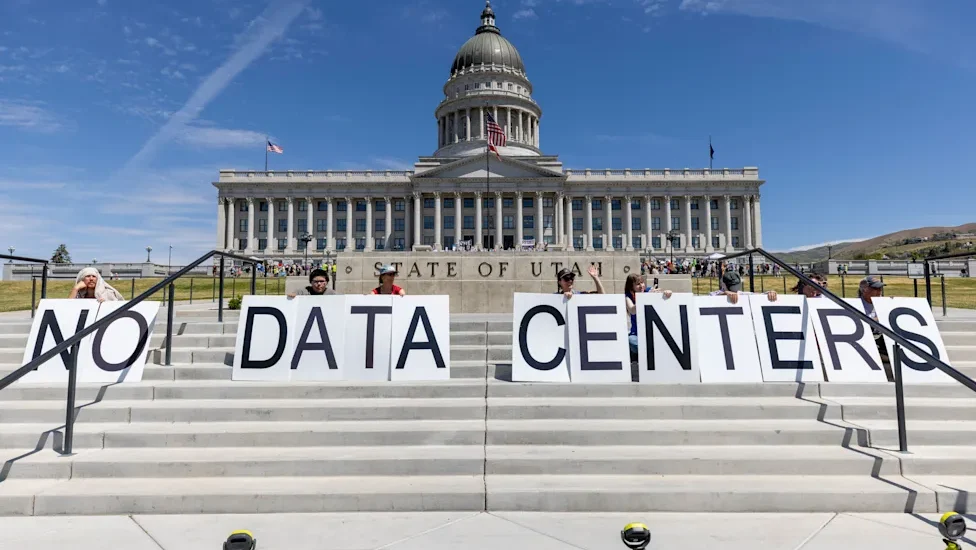
Data centers rarely made headlines outside tech and business publications until fairly recently. Now they’re a genuine political flashpoint, with the president pushing for more of them while a meaningful share of Americans living near proposed sites actively oppose new construction — a tension that’s becoming a real business risk for the AI industry building them.
What’s Actually Driving This Political Divide
President Trump has publicly pushed for significantly more data center construction, framing it as essential to maintaining America’s AI competitiveness, while polling suggests most Americans hold a genuinely different view, according to Yahoo Tech’s breakdown of the divide, reflecting a real disconnect between national AI-competitiveness policy goals and local community reactions to specific proposed data center sites.
Why Local Communities Are Increasingly Resistant
Concerns driving local opposition to new data centers typically center on genuinely concrete, local impacts: significant electricity consumption potentially raising regional utility rates, substantial water usage for cooling systems in water-stressed areas, and construction changing the character of previously residential or rural areas — concerns that are considerably more tangible and immediate to nearby residents than abstract national AI-competitiveness arguments.
Why the Administration Views This as a National Priority Regardless
The argument for more domestic data center capacity centers on maintaining competitive AI infrastructure relative to other countries, particularly China, in an industry where compute capacity has become a genuinely significant strategic and economic asset — a framing that treats data center expansion as comparable to other historically prioritized infrastructure investments, even when specific local siting decisions prove contentious.
The Business Risk This Creates for AI Companies Specifically
AI companies planning data center expansion now face a genuinely more complicated siting calculation than in previous years — balancing available power infrastructure and land against a real, growing likelihood of organized local opposition and potential political friction, a consideration that’s increasingly factored into site-selection timelines and cost estimates industry-wide.
How This Connects to the Broader AI Infrastructure Race
Data center capacity constraints have become one of the most binding real-world limits on how quickly AI companies can actually scale their infrastructure, a dynamic covered in our breakdown of Nvidia’s Vera Rubin architecture and its business case, where chip efficiency improvements partly address the same underlying power-availability constraint that’s fueling local data center opposition in the first place.
Why This Debate Isn’t Breaking Down Along Simple Party Lines
Local opposition to specific data center proposals has emerged across communities with genuinely varied political leanings, since the core concerns — electricity costs, water usage, local character change — affect residents regardless of broader political affiliation, making this less a clean partisan divide and more a national-priority-versus-local-impact tension that cuts across typical political lines.
What This Means for Businesses Planning AI Infrastructure Investment
Companies planning significant data center investment should factor genuine community engagement and local impact mitigation into project timelines from the outset, rather than treating local opposition as a secondary consideration after site selection is already finalized. This connects to [CLIENT LINK PLACEHOLDER] the broader pattern of AI infrastructure buildout increasingly requiring genuine stakeholder management, not just capital and technical planning, as public awareness of data centers’ local impact continues growing.
Frequently Asked Questions
Why do data centers use so much water specifically?
Most data centers rely on water-based cooling systems to manage the heat generated by densely packed servers running continuously, and the scale of AI-focused facilities specifically has increased water consumption compared to earlier, less compute-intensive data center generations.
Is local opposition actually stopping data center projects, or just slowing them?
Outcomes vary by specific project and location — some proposals have been modified or relocated in response to opposition, while others have proceeded largely as originally planned after addressing specific community concerns.
The Bottom Line
The genuine gap between national AI-competitiveness priorities and local community reactions to specific data center proposals reflects a real, ongoing tension that AI companies increasingly need to navigate as a core part of infrastructure planning, not a side issue that resolves itself as the industry continues scaling.