How Sustainable Packaging Is Reshaping Global Food Brands in 2025 and Beyond

 Business
 How Sustainable Packaging Is Reshaping Global Food Brands in 2025 and Beyond
In today’s competitive global food market, packaging has evolved far beyond its original function. It is no longer simply a container — it is a statement of values, a signal of brand responsibility, and an increasingly important factor in long-term business strategy. As environmental regulations tighten across major economies and a new generation of consumers makes purchasing decisions based on ethics as much as price, forward-thinking food brands are pivoting toward compostable packaging solutions that align with circular economy goals and reduce long-term environmental liability.
Packaging Laws Are Changing Fast
The regulatory landscape for food packaging is shifting at a pace that has caught many brands off guard. From California’s Extended Producer Responsibility (EPR) legislation to the European Union’s EN13432 compostability directive, 2025 is shaping up to be a genuine turning point for packaging compliance globally. Multinational foodservice companies are under mounting pressure to eliminate non-degradable plastics and replace them with certified sustainable materials that satisfy both regulatory bodies and increasingly vocal consumers.
Crucially, governments are no longer simply encouraging this transition — they are enforcing it. Import restrictions, labeling penalties, and mandatory carbon reporting are becoming standard tools of regulatory oversight. Brands that delay action risk not only financial penalties but reputational damage that can be difficult to reverse. The window for voluntary, proactive adaptation is narrowing, and companies that move now will be far better positioned than those waiting for a final deadline.
For multinational food and beverage companies, this means auditing supply chains, reviewing current material certifications, and working with manufacturers who can demonstrate genuine compliance — not just marketing language.
From Brand Value to Consumer Loyalty
Regulatory pressure alone does not fully explain the pace of change. Consumers themselves are driving significant demand for sustainable packaging, often ahead of any legal requirement. They are making active purchase decisions based on packaging ethics, and this trend is particularly pronounced among younger demographics.
This presents a rare and timely opportunity. Brands that act decisively on sustainable packaging do not simply achieve compliance — they earn loyalty, create meaningful differentiation, and build positive brand equity that compounds over time. In a crowded marketplace where product parity is common, packaging can become a genuine competitive advantage. The brand that communicates environmental responsibility clearly and credibly through its packaging often wins the shelf — and the repeat purchase.
Bio-Based Materials at the Centre of the Revolution
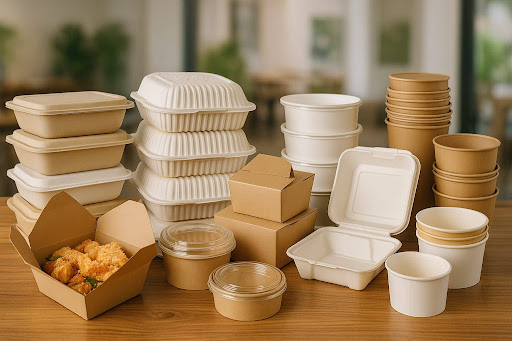
The good news for food brands making this transition is that the range of viable, high-performance sustainable materials has expanded considerably. Among the most promising alternatives currently available at commercial scale are:
- Bagasse — a sugarcane byproduct that can be moulded into sturdy clamshells, trays, and bowls suitable for both hot and cold food applications.
- Kraft paper combined with PLA film — an effective solution for salad bowls, soup containers, and retail-ready packaging that requires a degree of moisture resistance.
- CPLA and cornstarch blends — widely used for heat-resistant cutlery and lid solutions, offering a genuinely functional alternative to conventional plastic.
Each of these materials brings its own performance profile, and the right choice depends on the specific food type, temperature requirements, transport conditions, and end-of-life disposal infrastructure available in the target market. Brands are increasingly turning to international manufacturers who can offer volume production, relevant certifications, and the ability to customise packaging for private label or branded applications.
One manufacturer operating at this intersection of scale and certification is Bioleader Pack, a China-based producer that exports to over 30 countries. Their product range spans moulded bagasse clamshells to eco-friendly kraft bowls, all manufactured to EN13432 and ASTM D6400 compostability standards. With BRC and ISO certifications, full traceability across the supply chain, and a vertically integrated factory system, Bioleader supports brands in meeting both their compliance and branding requirements without having to manage multiple suppliers.
A Practical Example: Compostable Packaging Replacing PET in Europe
Theory is useful, but real-world outcomes are more persuasive. A European meal prep brand recently made the transition from conventional PET plastic containers to kraft paper bowls lined with compostable PLA film. The results were measurable and meaningful across several dimensions.
- The brand reduced its landfill output by 65 percent.
- Shelf aesthetics improved noticeably, with the natural, tactile quality of kraft paper strengthening the brand’s positioning as a premium, health-conscious product.
- The new packaging achieved full compliance with EU compostability standards, removing regulatory risk from the equation entirely.
The transition was supported by compostable packaging solutions that included heat-resistant bowls, leak-proof lids, and private label printing — demonstrating that sustainable packaging need not compromise on functionality or brand presentation. This case illustrates that the switch from conventional plastics to certified compostable alternatives is both operationally achievable and commercially beneficial when planned carefully with the right manufacturing partner.
What Brands Should Be Doing Right Now
For food and beverage companies still in the early stages of this transition, the most important step is to move from awareness to action. That means assessing which packaging formats are currently non-compliant or likely to become so, identifying certified alternative materials that meet the performance requirements of each application, and beginning conversations with manufacturers who have the capacity and credentials to deliver at scale.
It also means thinking about packaging not as a cost centre but as a strategic asset. Brands that frame sustainable packaging as an investment — in regulatory resilience, consumer trust, and long-term brand equity — tend to make better decisions than those treating it purely as a compliance exercise. The upfront transition costs are real, but the long-term benefits in loyalty, market access, and reputational strength are demonstrably greater.
Sustainability as a Competitive Strategy
The broader shift toward sustainable packaging in the global food industry is not a passing trend — it reflects a fundamental realignment of regulatory expectations, consumer values, and corporate responsibility standards. Brands that recognise this early and build it into their core strategy will find themselves better positioned competitively, more resilient to regulatory change, and more trusted by the consumers they rely on.
Now is the time to rethink not just what your product delivers — but how it is delivered. The packaging around your food is communicating something to every customer who touches it. The question is whether that message is one you have chosen deliberately, or one you have allowed to be decided by default.
To learn more about scalable, compliant, and cost-effective options, visit Bioleader Packaging to explore their full range of certified compostable solutions for food brands operating across global markets.


