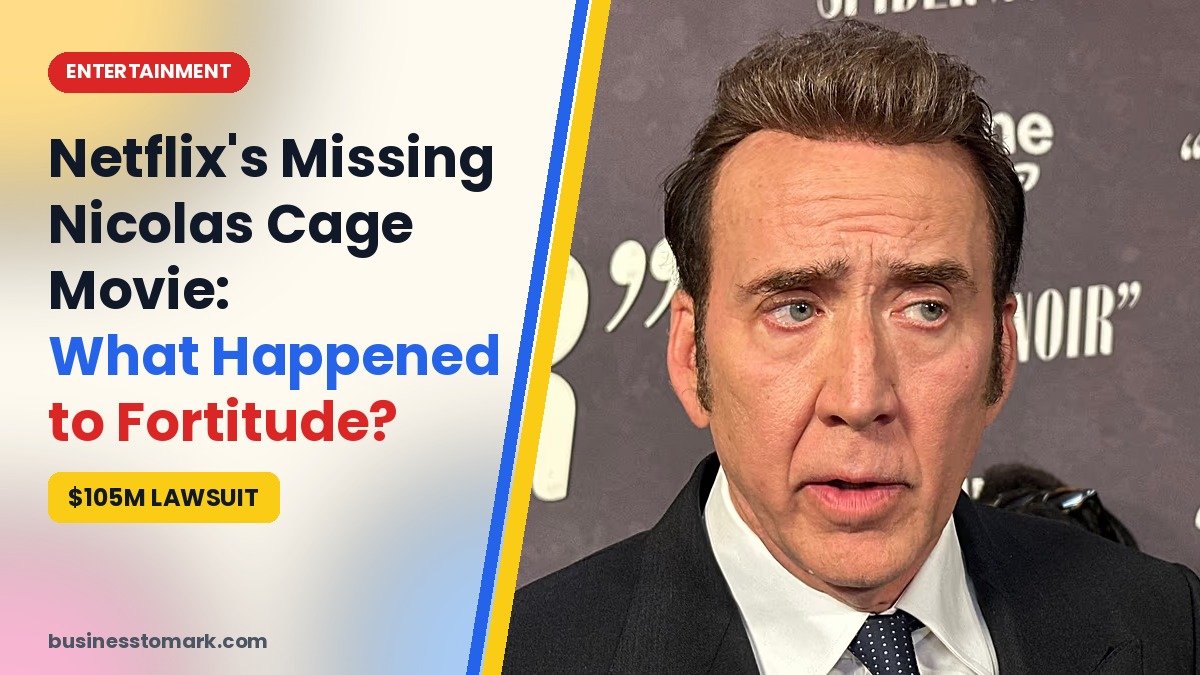
Hollywood has seen leaked scripts, pirated screeners, and films shelved for tax write-offs. But a finished, $45 million Nicolas Cage spy thriller allegedly walking out of a streaming giant’s office on a hard drive? That’s a new one.
That’s the strange situation surrounding Fortitude, a World War II espionage film starring Nicolas Cage, Ben Kingsley, and Michael Sheen. The movie’s producers say a digital copy of the completed film was stolen from Netflix’s Los Angeles office in June 2026, and they’re now suing Netflix for $105 million. Netflix, for its part, rejects responsibility and says it has found no sign the film has leaked online.
If you’ve seen the headlines and wondered what actually happened, why the case matters, and whether you’ll ever get to watch the movie, this guide pulls the full story together in one place. For more stories like this, browse the latest in our Entertainment section.
Fortitude at a Glance: Key Facts
| Title | Fortitude |
| Genre | World War II spy thriller / caper |
| Director | Simon West (Con Air, The Expendables 2) |
| Lead star | Nicolas Cage as real-life double agent Duško Popov |
| Reported budget | About $45 million, independently financed |
| Development time | Roughly seven years |
| Producer suing | Op-Fortitude Ltd., run by writer-producer Simon Afram |
| Damages sought | $105 million, plus interest |
| Lawsuit filed | July 31, 2026, in federal court in California |
| Release status | Unreleased; no confirmed distributor |
What Is Fortitude About?
Fortitude dramatizes one of the most audacious deception campaigns in military history: Operation Fortitude. In the months before D-Day in 1944, Allied intelligence worked to convince Nazi Germany that the main invasion of Europe would land somewhere other than Normandy — most famously at the Pas-de-Calais.
The real operation relied on double agents feeding false reports to German intelligence, fake radio traffic, and even inflatable tanks and dummy equipment arranged to look like a massive army waiting to cross the Channel. You can read a solid overview of the history in this summary of Operation Fortitude.
According to reports on the film’s trailer, the story follows British intelligence officers Dudley Clarke and Thomas Argyll Robertson as they run the scheme, with help from Winston Churchill and Ian Fleming. The double agents at the center of the plan include:
- Duško Popov (Nicolas Cage) — a Serbian playboy spy often cited as one of the inspirations for James Bond.
- Juan Pujol — the Spanish double agent known by the codename Garbo, who invented an entire network of fictional informants.
- Nancy Armstrong — a British agent woven into the deception effort.
Rather than a grim war drama, the film is pitched with a lighter, heist-style energy. The filmmakers have compared its tone to ensemble capers like Ocean’s 11 and stylized war films like Inglourious Basterds, and early trailer coverage likened it to Guy Ritchie’s recent WWII romp The Ministry of Ungentlemanly Warfare.
The Cast
For an independent production, Fortitude assembled an impressive ensemble. Alongside Cage, reported cast members include:
- Ben Kingsley
- Michael Sheen
- Ron Perlman
- Matthew Goode
- Alice Eve
- Ed Skrein
- Art Malik
- Jordi Mollà
The production was also reportedly shot on 35mm film, a choice that adds texture and period feel — and cost — to a project of this scale.
What Happened to Fortitude? The Timeline
Here’s how events unfolded, based on the producers’ lawsuit and widely reported coverage. Keep in mind that these are allegations made in a legal complaint, and Netflix disputes key parts of them.
- Mid-June 2026 — The film goes to Netflix. The producers say they delivered a digital cinema package (DCP) of the finished film to Netflix around June 16 so the streamer could evaluate it for potential distribution. A DCP is the high-quality master file format used to project films in cinemas.
- The drive is left unprotected. According to the complaint, the copy was unencrypted, and the hard drive was left on a desk at Netflix’s office in Hollywood.
- Around June 25, 2026 — The drive is reported stolen. The producers allege the drive disappeared during a break-in at the Los Angeles office.
- Marketing and sales stall. With a pristine, unprotected copy of the movie potentially circulating, the producers say they paused efforts to market and sell the film.
- July 31, 2026 — The lawsuit is filed. Op-Fortitude Ltd. sued Netflix in federal court in California, seeking $105 million.
- September 2026 — A trailer arrives. The first trailer debuted with no distributor logo attached, a telling sign that the film’s release path is still unresolved.
Detailed reporting on the case is available from Rolling Stone and FOX 5 DC, which covered the lawsuit when it was filed.
Fans who want to keep up with the biggest streaming releases and entertainment news can also check out [CLIENT ANCHOR TEXT HERE] for more coverage.
Inside the $105 Million Lawsuit
Who is suing — and why?
The plaintiff is Op-Fortitude Ltd., a British company run by Swiss writer-producer Simon Afram, who spent years developing the project. The core argument is straightforward: the producers trusted Netflix with an extremely valuable asset, the streamer allegedly failed to keep it secure, and the theft has damaged the film’s commercial value.
Why would one stolen drive cause so much harm? Because an independent film’s value depends heavily on exclusivity. Distributors pay for the right to be the first and only place audiences can see a movie. If a high-quality copy could leak online at any moment, buyers become cautious, offers shrink, and the risk of piracy wiping out box office and streaming revenue rises sharply.
How did they arrive at $105 million?
Reports indicate the producers point to several factors to justify the figure:
- The production budget of roughly $45 million.
- Projected revenue the producers estimated at a minimum of about $112.5 million.
- Strong test screenings, with reports citing an 82% “top-two box” audience score — a measure of how many viewers rated the film in the top two categories.
- Seven years of development and the lost opportunity of a clean, controlled release.
Coverage also notes that the producers’ earlier demand was reportedly higher, at around $165 million, before the lawsuit settled on the $105 million figure.
What Netflix says
Netflix disputes liability. In statements reported by multiple outlets, the company said it takes content security seriously, has taken additional precautions, and has found no evidence the film has leaked. It also argued that the producers delivered the drive without the safeguards that are standard in the film industry — an implicit reference to the fact that the DCP was reportedly unencrypted. Netflix has reportedly offered help monitoring for any leak.
In other words, Netflix’s position suggests that if an unprotected master copy was handed over, at least part of the responsibility sits with the people who handed it over.
Why Was an Unencrypted Copy Such a Big Deal?
This is the detail that has surprised many people in the industry. In modern film distribution, DCPs sent to cinemas are typically encrypted. Theaters receive a separate digital “key” — known as a KDM — that unlocks the film only on specific projectors and only during approved dates. Without that key, the file is essentially useless.
An unencrypted DCP is different. Anyone who gets hold of it can potentially play, copy, or convert the full-quality film. That’s why both sides are pointing at the encryption question:
- The producers argue the recipient should have kept such a valuable, sensitive file locked away.
- Netflix argues that industry practice means a film shouldn’t be delivered in that unprotected state in the first place.
How a court weighs those competing arguments could become an important reference point for how studios, streamers, and independent producers handle film assets in the future.
Has Fortitude Leaked Online?
As of the latest reports, there’s no public evidence that Fortitude has leaked. Netflix has said it found no sign of the film circulating, and no credible reports have surfaced of the movie appearing on piracy sites.
That said, the risk is exactly what makes the situation so damaging for the producers. A leak could happen tomorrow, next month, or never — and that uncertainty alone is enough to make distributors nervous. If you come across a site claiming to stream the full film, be very cautious: it’s far more likely to be a scam or malware trap than a real copy.
Will Fortitude Ever Be Released?
The short answer: probably, but the path is unclear.
The good news for fans is that the film itself still exists. Losing a drive doesn’t mean losing the movie — the producers retain their original materials. The appearance of a full trailer in September 2026 is also a strong signal that the team intends to bring the film to audiences.
Here’s what we know about its release prospects:
- A Netflix deal appears to be off the table. Given the lawsuit, a distribution partnership with Netflix now seems very unlikely.
- No distributor has been confirmed. The trailer carried no studio or distributor logo.
- A theatrical release had been planned. Earlier coverage of the trailer indicated the film was aimed at cinemas, though timing is now uncertain.
- The lawsuit could shape the timing. Legal disputes can delay deals, especially when damages depend on how the film eventually performs.
Film Stories has a good write-up of the Fortitude trailer and release outlook if you want to see how the film is being positioned.
What This Case Means for Hollywood and Streaming
Beyond the Nicolas Cage headlines, the Fortitude case touches on real business issues that matter to anyone in the content industry.
1. Content security is a business risk, not just an IT issue
A single unsecured file can put tens of millions of dollars at risk. Studios and streamers already use watermarking, encryption, secure screening rooms, and tightly controlled access systems — but this case shows how one weak link in the chain can undo all of it.
2. Independent producers carry outsized risk
A major studio can absorb a setback on one title. An independent production company that has spent seven years and $45 million on one film cannot. That imbalance is a big part of why the producers are pursuing such a large claim.
3. Responsibility during “evaluation” is murky
When a film is sent to a potential buyer to be considered — but no deal is signed yet — who is responsible for keeping it safe? Contracts, delivery terms, and non-disclosure agreements usually cover this, and the details of those agreements are likely to be central to the case.
4. Piracy fears still shape distribution
Even in the streaming era, the fear of a high-quality leak can freeze a film’s commercial life. Buyers want exclusivity, and a potential leak undermines the core value of what they’re buying.
If you follow how big companies manage risk and reputation, our Business section covers more stories where corporate decisions collide with real-world consequences.
The Real Spy Behind Nicolas Cage’s Character
Part of what makes Fortitude intriguing is the true story behind Cage’s role. Duško Popov was a Serbian lawyer and socialite who worked as a double agent for British intelligence under the codename Tricycle. He was famous for his glamorous lifestyle — casinos, fast cars, and high society — and historians often mention him as one of the real-life figures who may have influenced Ian Fleming’s James Bond.
Popov fed misleading information to German intelligence and played a role in the wider Allied deception network that made D-Day possible. It’s easy to see why the role suits Cage, an actor known for leaning into big, charismatic, slightly unhinged characters. For a deeper look at his life, this profile of Duško Popov is a useful starting point.
What Happens Next?
Several things are worth watching over the coming months:
- Netflix’s formal legal response to the complaint and any early motions to dismiss or narrow the case.
- Whether the missing drive is recovered or whether police investigations produce any leads.
- A distribution announcement naming a studio, streamer, or theatrical partner.
- A possible settlement, which is common in commercial disputes of this kind and could happen quietly at any stage.
- Any sign of a leak, which would significantly change the stakes for both sides.
Frequently Asked Questions
Is Fortitude a Netflix original movie?
No. Fortitude is an independently produced film. It was sent to Netflix for potential distribution, but no Netflix release was confirmed.
Who is suing Netflix over Fortitude?
Op-Fortitude Ltd., the British production company behind the film, run by writer-producer Simon Afram.
How much is the Fortitude lawsuit worth?
The producers are seeking $105 million in damages, plus interest and additional costs.
Who stars in Fortitude?
Nicolas Cage leads the cast alongside Ben Kingsley, Michael Sheen, Ron Perlman, Matthew Goode, Alice Eve, and Ed Skrein, among others.
Can I watch Fortitude now?
No. The film has not been officially released on any platform or in theaters. Avoid websites claiming to offer the full movie.
Is Fortitude based on a true story?
Yes. It’s inspired by Operation Fortitude, the real Allied deception campaign that helped mislead Nazi Germany ahead of the D-Day landings in 1944.
Final Thoughts
The story of Fortitude has become stranger than many movie plots: a film about wartime deception and stolen secrets now finds itself at the center of a real-world mystery over a missing hard drive. Whether the court sides with the producers or with Netflix, the case is already a cautionary tale about how fragile a film’s value can be before release.
For now, the movie remains unreleased, the drive remains missing, and the $105 million question is still unanswered. We’ll be watching closely for a distribution deal or a courtroom update. In the meantime, catch up on more stories from our Entertainment section, and for ongoing coverage of the case, Gulf News has also reported on the lawsuit’s key details.


:max_bytes(150000):strip_icc():format(webp)/michael-douglas-kathleen-turner-100226-1-65be599328824dfeae59e02a462d3409.jpg?w=640&resize=640,400&ssl=1 "Michael Douglas Reveals Secret Romance With Kathleen Turner After 40 Years")