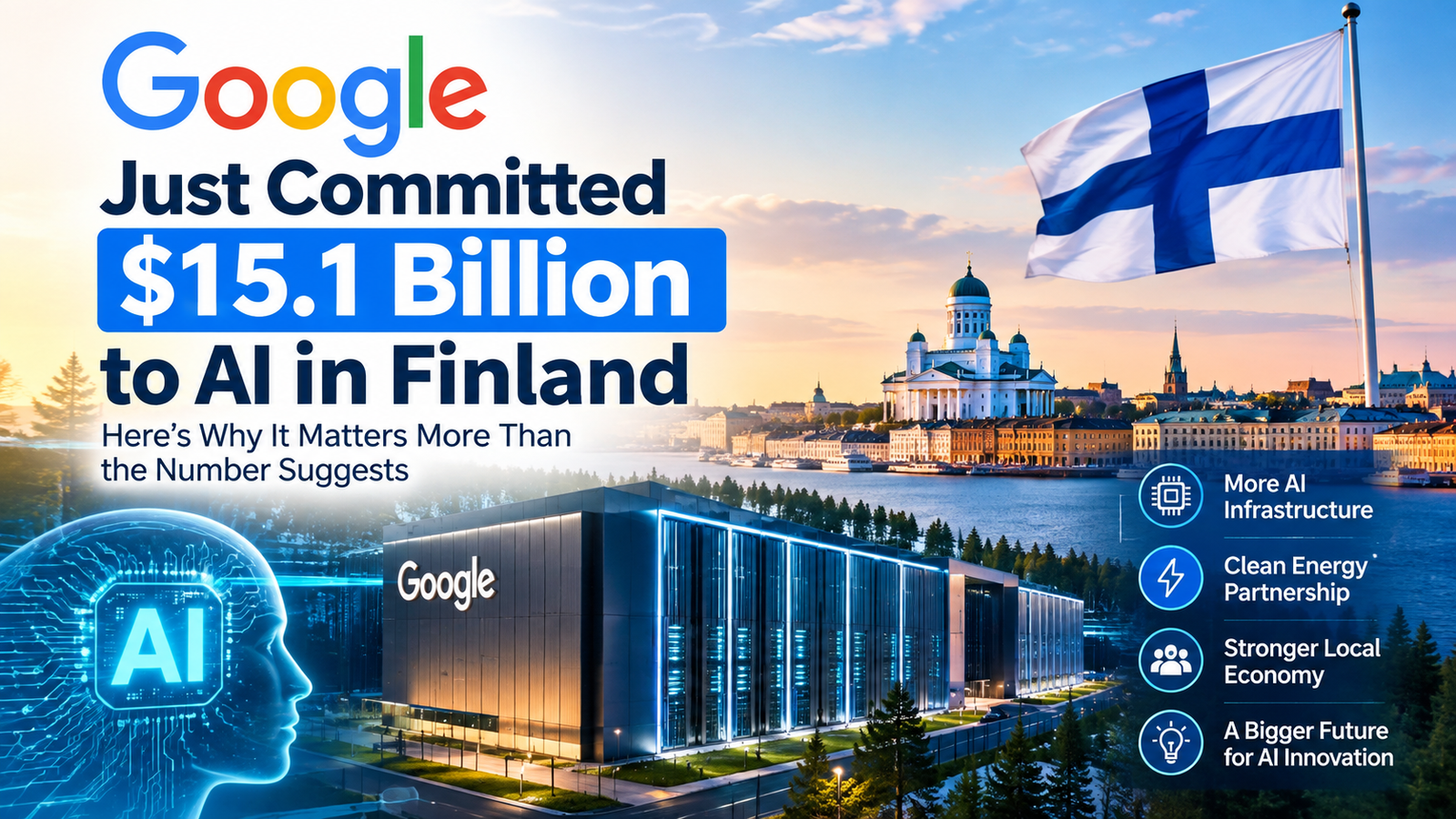
Google just placed its largest-ever European bet on artificial intelligence, and the country it chose says as much about the future of AI infrastructure as the dollar figure does. On September 9, 2026, Google announced a €13 billion ($15.1 billion) investment into AI infrastructure in Finland — new data centers, expanded energy capacity, and grid upgrades spread across four Finnish municipalities. It’s a case study in where the AI industry is actually putting its money right now, and why that location increasingly isn’t Silicon Valley.
In this article
- What Google Is Actually Building
- Why Finland, Specifically
- The Numbers Behind the Headline Figure
- This Fits a Much Bigger Spending Pattern
- How Markets Reacted to the Bigger Spending Story
- A Quick Look at the Site-Selection Logic Other Companies Are Following
- What Happens to the Communities Hosting These Facilities
- How Google’s Capex Guidance Has Moved Through 2026
- What Critics Are Pointing Out
- What This Means If You Run an AI-Dependent Business
- The Broader Nordic AI Infrastructure Race
- Frequently Asked Questions
- The Bottom Line
What Google Is Actually Building
The investment funds new data centers in Kajaani, Muhos, and Vaala, plus an expansion of Google’s existing facility in Hamina, all over the next two years. According to Google’s own announcement covered by CNBC, this marks the company’s single largest investment in Europe to date — a meaningful marker given how aggressively every major AI lab has been racing to secure compute capacity throughout 2026.
 Also readWhat Is SpaceX and How Does It Work? A Complete Beginner’s Guide to Elon Musk’s Space Company in 2026
Why Finland, Specifically
Finland has quietly become one of the AI industry’s preferred data center locations, and the reasons are mostly about physics and geography rather than tax breaks. Its cold climate dramatically cuts the cooling costs that make data centers expensive to run, its grid runs on a high share of low-carbon power, and — critically in an industry now bottlenecked as much by electricity as by chips — it has available land and grid capacity that’s become scarce across much of the rest of Europe. Google isn’t alone in noticing this: TikTok is separately building a €1 billion facility in Finland, and the broader Nordic region has become a genuine hotspot for hyperscale AI infrastructure specifically because of this power-and-land combination.
The Numbers Behind the Headline Figure
Google says the initiative will contribute an average of $4.2 billion annually to Finland’s GDP during the two-year construction phase and support more than 37,000 jobs while it’s being built. Once the facilities are operational, Google projects roughly 7,000 ongoing jobs, with average wages about 24% above Finland’s median. Businesses tracking how generative AI is reshaping corporate operations will recognize the pattern here: the AI boom’s economic footprint increasingly shows up as physical infrastructure investment and skilled local jobs, not just software deals.
This Fits a Much Bigger Spending Pattern
This Finland investment doesn’t exist in isolation — it’s one piece of a capital spending surge that’s reshaping Google’s entire cost structure in 2026. The company has told investors to expect total 2026 capital expenditure between $175 billion and $185 billion, nearly double the prior year and well above what analysts had modeled. Alphabet also raised $80 billion earlier in 2026 through a mix of equity offerings and a $10 billion private placement from Berkshire Hathaway specifically earmarked to fund AI compute buildout — a sign of just how capital-intensive the current phase of the AI race has become, even for a company with Google’s existing cash generation.
How Markets Reacted to the Bigger Spending Story
It’s worth noting that aggressive AI capex hasn’t been an unambiguous win with investors. When Google first disclosed the $175-185 billion capex range earlier this year, its shares initially dropped more than 7% in after-hours trading before recovering somewhat, reflecting real investor anxiety about whether AI infrastructure spending is outpacing the revenue it’s generating. That tension — invest aggressively now or risk falling behind competitors versus the near-term hit to margins — is the backdrop every one of these regional infrastructure announcements gets read against. If you’re tracking how this kind of spending decision fits into broader [CLIENT LINK PLACEHOLDER] investment analysis, Google’s Finland bet is a useful real-world case of a company choosing long-term infrastructure positioning over near-term margin optics.
A Quick Look at the Site-Selection Logic Other Companies Are Following
Google’s Finland decision is part of a broader pattern that’s worth understanding on its own terms. Hyperscale AI infrastructure providers increasingly evaluate potential sites on a fairly consistent checklist: ambient temperature (colder climates cut cooling costs dramatically), grid capacity headroom, the carbon intensity of the local power mix, political and regulatory stability, and available land near existing fiber and power infrastructure. Finland scores well on nearly every one of these simultaneously, which is a big part of why it’s attracting hyperscaler investment from multiple companies at once rather than being a one-off Google decision.
What Happens to the Communities Hosting These Facilities
Kajaani, Muhos, and Vaala are not major Finnish cities — they’re smaller municipalities where a multibillion-dollar infrastructure project represents a meaningfully larger economic shift than the same investment would in a major metro area. The promised wage premium (24% above Finland’s median) and the scale of construction-phase employment are significant enough that local officials have been actively courting this kind of investment, rather than merely accepting it passively. That local economic dynamic is a big part of why Finland’s own government leaders were so vocally supportive in their public statements about the deal.
How Google’s Capex Guidance Has Moved Through 2026
It’s worth tracking how much Google’s own spending expectations have shifted over the course of the year. The $175-185 billion capex range disclosed earlier in 2026 was already nearly double the prior year’s spending and came in well above what Wall Street analysts had modeled going into the year. That upward revision, paired with the $80 billion capital raise completed mid-year, shows a company continuously recalibrating its spending upward as AI demand outpaces even its own aggressive earlier projections — a pattern that’s shown up across most of the major hyperscalers, not just Google.
What Critics Are Pointing Out
Not every reaction has been positive. Some industry observers have specifically flagged a lack of transparency around the exact power draw of the new sites — Google detailed its wind and nuclear capacity additions but hasn’t disclosed precise energy consumption figures for the facilities themselves. For a project explicitly framed around energy responsibility, that’s a gap worth watching as the facilities move from announcement to construction over the next two years.
What This Means If You Run an AI-Dependent Business
For companies building products on top of Google Cloud’s AI services, infrastructure investments like this one are a leading indicator of where compute capacity and, eventually, pricing competition will loosen up. Regional data center expansion typically precedes lower latency and, over a longer horizon, more competitive pricing for cloud AI services in and around that geography. If your team is evaluating how tools like ChatGPT and similar AI assistants fit into daily business operations, the underlying compute economics behind those tools are exactly what investments like Google’s Finland buildout are trying to solve at scale.
The Broader Nordic AI Infrastructure Race
Finland’s Prime Minister Petteri Orpo and Climate Minister Sari Multala both framed the deal publicly as validation of Finland’s approach to attracting AI infrastructure investment — pairing it explicitly with clean energy and grid modernization rather than treating it as a purely industrial deal. Whether other countries competing for the same hyperscaler investment dollars adopt a similar framing will be one of the more interesting regional policy stories to watch through the rest of 2026.
Frequently Asked Questions
Is this Google’s biggest AI investment overall, or just in Europe?
Specifically in Europe — it’s described as Google’s largest single investment on the continent. Globally, Google’s total 2026 AI-related capital expenditure ($175-185 billion) is far larger and spans data centers across multiple countries and regions.
When will the new Finnish data centers actually be operational?
The investment is planned over roughly a two-year construction window (2027-2028), with the Hamina facility expansion and the three new sites in Kajaani, Muhos, and Vaala progressing on overlapping timelines.
Does this affect Google Cloud pricing for existing customers?
Not immediately — capacity investments like this typically take one to two years to translate into pricing or availability changes, though they’re a reasonable signal of where regional capacity (and eventually competitive pricing) is headed.
The Bottom Line
Google’s $15.1 billion Finland investment is less a one-off announcement than a data point in a much larger story: AI infrastructure spending has become so capital-intensive that even the largest tech companies are restructuring their balance sheets around it, and the countries that can offer cheap, clean, reliable power and available land are becoming the new centers of gravity for where that money actually lands. For businesses and investors watching this space, the more useful habit than reacting to any single headline number is tracking the pattern across announcements — where the money keeps landing tells you more about the industry’s real constraints than any single company’s press release does on its own.