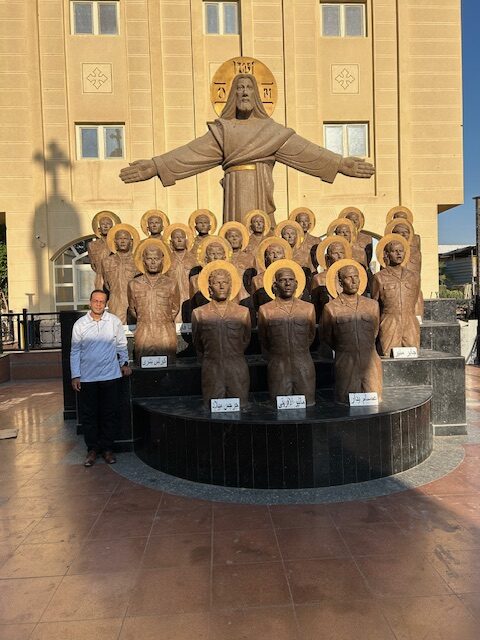
People often come to Mike Bishai — Conroe, Texas physician — carrying years of pain that never seems to let up. Sometimes it’s physical, and other times emotional. Often, it’s both.
With 30 years of experience in medicine specialized in both psychiatry and pain management, he has built a practice in The Woodlands that treats emotional and physical pain as inseparable parts of the same experience.
That perspective was not inherited or handed to Bishai. It grew from decades of training, unexpected challenges, and moments where his faith carried him through. Throughout his career, he’s come to believe that people want to feel seen in the fullness of what they are living through, not reduced to a single symptom or diagnosis.
With that belief as his guide, he continues to meet people with the kind of care that inspires hope and helps them move toward healing.
A Calling Sparked in Cairo
As a young boy growing up in Cairo, Bishai watched a black-and-white movie in which a knighted Egyptian actor played a compassionate physician who stepped in to help an orphaned young woman. He offered her safety, stability, and dignity. It was one of the first times Bishai saw how a single act of care could change the direction of another person’s life.
Years later, at the start of his internship, he watched “Patch Adams” and felt something click.
“When I got older, I was really inspired by Robin Williams and his iconic movie ‘Patch Adams’,” he said. “I watched it in the beginning of my internship and decided to adopt most of his passion and ideas.”
He often links those two early influences, seeing them as the defining moments that shaped his understanding of the kind of doctor he wanted to become. They pointed him toward a profession defined not by prestige, but by genuine care. His commitment has always been to offer the highest level of treatment to every patient, regardless of their financial circumstances.
Looking back, he wouldn’t change a single decision, even though there have been setbacks along the way. He sees success not in titles or achievements, but in the moments when a patient tells him they finally feel better after years of suffering. That is the standard he returns to every day.
Training Across Continents
Emad Bishai, Woodlands-based doctor, entered Cairo University Medical School at just 17 years old. By 23, he had finished medical school. Four years later, at 27, he moved to the United States, where he took a research position at Mount Sinai School of Medicine in New York.
Guided by a growing passion for mental health, he began his psychiatric residency in 2001. It was there that he gained experience treating emotional and psychological conditions that often hid beneath layers of stress, trauma, or chronic illness.
His early clinical years showed him just how much people struggled to feel understood and how difficult it was to address mental health without also acknowledging what was happening in the rest of the body.
In 2005, he took a leadership role as Medical Director at Pinnacle Health System in Central Pennsylvania while also serving on the faculty at Penn State Hershey.
By 2009, he completed a pain management fellowship at the University of Pittsburgh Medical Center, a step that made it possible for him to bring together the two fields he cared about most. He was one of the first psychiatrists to pursue pain medicine, combining it with his psychosomatic background to form an approach he’s still proud of today.
In 2010, he moved to The Woodlands, where he continues treating patients whose experiences often blur the line between physical pain and emotional suffering.
Innovations and the Crisis That Followed
Once Emad Bishai entered private practice, he made a personal commitment that would drive many of his future achievements.
“From day one in private practice, I made a personal vow…an extension of my Hippocratic oath…to relentlessly stay up to date with the latest innovative techniques,” he said.
He followed through on it, adopting new FDA-approved treatments and giving his patients access to options that were still uncommon at the time.
In 2016, he implanted the first mini high-frequency spinal cord stimulator in Houston and only the third in the United States. He was also one of the first 350 surgeons in the entire world to be trained to use minimally invasive spine spacers to treat lumbar spinal stenoses and later on implanted the first 12 of those devices in the Middle East . This procedure addressed spinal stenosis with a level of precision that often surprised patients who had been told they were out of options.
Some of the most meaningful moments of his career have been in the operating room, and there’s one case he remembers especially well. A Marine had been left disabled after a grenade blast damaged his spine. Scar tissue blocked every attempt to advance the leads needed for a spinal cord stimulator, and the wires bent each time.


