
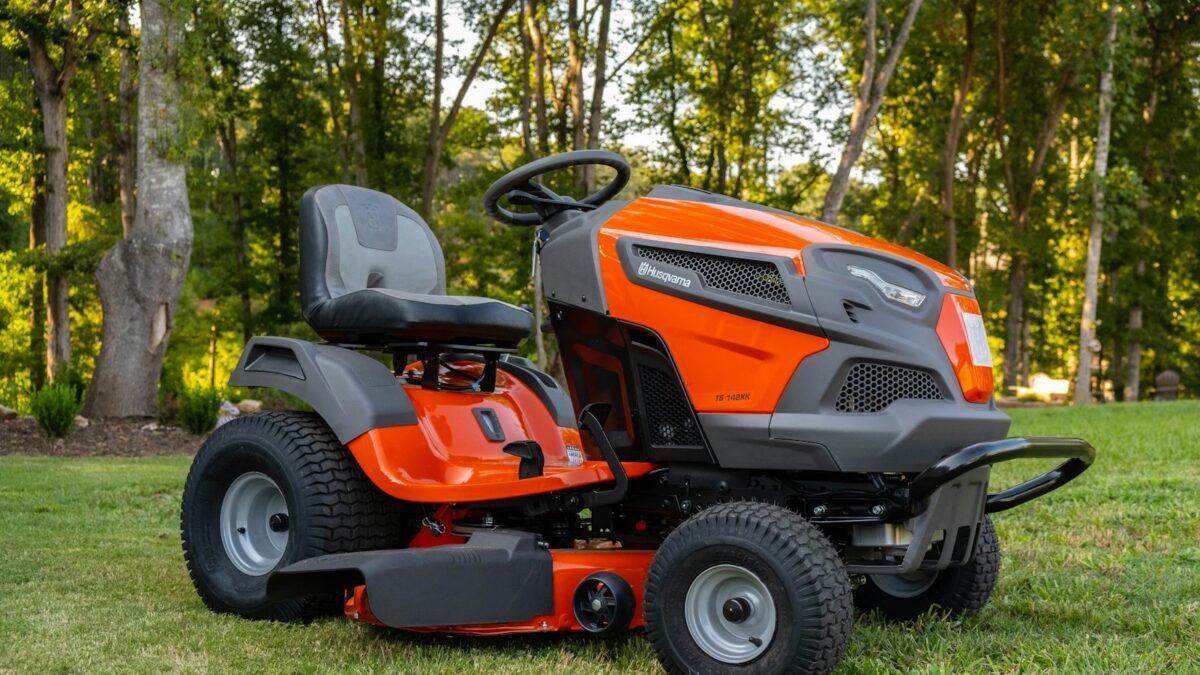
A riding mower can make maintaining a large lawn considerably easier, but its cutting capacity means little if it cannot reach the grass that needs mowing. A narrow garden gate, a winding side path, or a tight opening between a house and fence can turn an otherwise suitable machine into an impractical purchase.
Choosing ride-on mowers requires more than comparing horsepower, battery capacity, or cutting-deck width. Buyers must account for the machine’s overall dimensions, turning space, access routes, and storage requirements. Reviewing available ride on mowers alongside their published specifications can help narrow the options before measuring the property and committing to a particular model.
The smartest approach is to plan access first and choose cutting capacity second. A mower that fits the entire route comfortably often saves more time over a season than a wider model that struggles to reach half the lawn.
 Also readWhy Sofa Beds Are the Secret to Smart Modern Living
In this article
- Why Overall Mower Width Matters More Than Cutting-Deck Width Alone
- How to Measure Gates, Side Paths, and Other Tight Access Points
- How Cutting-Deck Size Affects Productivity and Access
- How Turning Radius and Mower Length Affect Narrow-Path Maneuverability
- How to Compare Riding Mowers for Gates, Storage, and Lawn Layout
- How to Plan a Safe Route Between the Storage Area and Every Lawn Section
- Common Sizing Mistakes That Lead to Difficult Mowing and Storage
- Frequently Asked Questions About Ride-On Mower Width and Deck Size
- The Best Mower Is the One That Fits the Entire Property
Why Overall Mower Width Matters More Than Cutting-Deck Width Alone
Cutting-deck width describes the span of grass the mower can cut in one pass. Overall machine width describes the space the complete mower occupies, which is the measurement that matters when passing through a gate or between obstacles.
These dimensions are not always identical. Depending on the design, tires, deck edges, discharge components, and other projecting parts may affect the machine’s widest point. A deck that appears narrow enough on paper may still create clearance problems along the access route.
Always consult the manufacturer’s dimensional drawings or specifications. Confirm whether the published width includes the grass-discharge chute and whether any components can be adjusted safely for transport. Never assume a chute can be folded or removed unless the manufacturer explicitly permits it.

How to Measure Gates, Side Paths, and Other Tight Access Points
Before shopping, measure the narrowest point between the mower’s storage location and every lawn section it must reach. Measuring only the main gate is insufficient if a wall, downspout, fence post, or sharp bend creates a tighter restriction farther along the route.
Use this checklist:
- Measure the clear opening between gateposts, not the gate panel itself.
- Account for hinges, latches, handles, and posts that project into the opening.
- Check path width at ground level and higher points where fences or walls may narrow the route.
- Measure tight turns and identify obstacles that prevent the mower from aligning straight with the opening.
- Record doorway and shed-opening dimensions if the mower will be stored indoors.
For example, a gate with a 42-inch clear opening does not automatically accommodate a mower listed as 41 inches wide. That leaves only half an inch on each side under ideal alignment, before accounting for steering error, uneven ground, or projecting components.
A larger clearance margin makes passage more practical and reduces the risk of scraping the machine or damaging the gate.
How Cutting-Deck Size Affects Productivity and Access
A wider cutting deck generally reduces the number of passes required across open grass. However, the benefit depends on lawn geometry, not just total acreage.
When a Wider Deck Makes Sense for Open Lawns
Large, unobstructed lawns often benefit from wider decks because fewer passes are needed to cover the same area. This can reduce mowing time when the machine has enough room to maneuver and the route contains few narrow sections.
The advantage becomes less pronounced when the property includes numerous trees, planting beds, narrow strips, or sharp corners. A wide deck may require additional repositioning and leave more areas that need trimming afterward.
When a Compact Deck Works Better for Confined Properties
Smaller decks can improve access around landscaping features and through restricted openings. They may also suit lawns with multiple disconnected sections, where the mower must repeatedly travel through narrow passages.
Consider a property with a broad front lawn and a fenced backyard reached through a side gate. A very wide mower might be efficient in front but unable to reach the backyard. A somewhat narrower model that accesses both areas could deliver better overall productivity.
How Turning Radius and Mower Length Affect Narrow-Path Maneuverability
Width is only one part of the access equation. A mower must also be able to approach a gate, pass through it, and turn safely once it reaches the lawn.
Turning radius influences how easily the machine can navigate around corners, while overall length affects the space required to align with an opening and maneuver near obstacles. Steering design and the operator’s ability to control the machine also matter.
Walk the intended route and identify corners where the mower may need to reverse or make several adjustments. Pay particular attention to paths that end in a small enclosed lawn, where there may not be enough space to turn around.
If possible, evaluate a demonstration model using a mock-up of the tightest opening. This practical test can reveal limitations that are difficult to judge from a specification sheet alone.
How to Compare Riding Mowers for Gates, Storage, and Lawn Layout
A useful buying decision balances cutting capacity against the property’s physical restrictions.
| Property condition | Mower characteristic to prioritize | Why it matters |
|---|---|---|
| Large, open lawn | Wider cutting deck | Reduces the number of mowing passes |
| Narrow garden gate | Compact overall width | Improves access and reduces contact risk |
| Several tight corners | Maneuverability and turning radius | Reduces repeated repositioning |
| Small storage shed | Overall length, width, and height | Ensures the mower can be stored safely |
| Separate lawn sections | Transport-route compatibility | Allows access to every mowing area |
| Uneven or sloping paths | Approved operating conditions and traction | Helps maintain safe control |
Do not rely on deck width alone when comparing models. Create a shortlist using the complete machine dimensions, turning requirements, recommended operating conditions, and the manufacturer’s transport guidance.
How to Plan a Safe Route Between the Storage Area and Every Lawn Section
A mower that fits through the gate may still be unsuitable if the approach is too steep, uneven, or obstructed. Access planning should therefore include both dimensions and surface conditions.
Start at the storage location and trace the route to each lawn section. Note slopes, drainage channels, loose gravel, raised thresholds, and surfaces that may become slippery when wet.
Next, identify whether the mower must cross pavement or travel along a shared walkway. Follow the manufacturer’s instructions for transport, slope limits, and operating conditions. Never drive a riding mower on a slope simply because the route appears wide enough.
If a section cannot be reached safely, consider whether a smaller walk-behind mower or trimmer would be more practical for that area. A mixed equipment setup can be more efficient than forcing one large machine to handle every part of the property.
Common Sizing Mistakes That Lead to Difficult Mowing and Storage
One frequent mistake is measuring the gate but forgetting the route beyond it. A mower may pass through the opening and then become trapped by a tight bend or an undersized storage shed.
Another is assuming that a deck’s advertised width equals the machine’s maximum transport width. Always verify the actual dimensions and clarify whether attachments or projecting components are included.
Buyers also sometimes prioritize the largest available deck without considering how much time they spend navigating obstacles. On a complex lawn, extra turning and trimming can offset the theoretical time saved by a wider cutting path.
Finally, avoid planning around an opening with almost no spare clearance. Gateposts are rarely perfectly aligned, paths can be uneven, and the operator needs room to steer without making contact.
For broader property and equipment safety considerations, the Consumer Product Safety Commission provides consumer safety resources, while Penn State Extension offers educational guidance on turfgrass and lawn management.
Frequently Asked Questions About Ride-On Mower Width and Deck Size
Is cutting-deck width the same as overall mower width?
No. The cutting deck measures the cutting span, while overall width reflects the machine’s widest point. Check the manufacturer’s specifications to determine the actual clearance required.
How much wider should a gate be than a riding mower?
There is no universal clearance figure for every machine and route. Provide enough additional space for accurate steering and projecting components, and test the tightest section whenever possible.
Does a smaller cutting deck always mean better maneuverability?
Not necessarily. Deck size affects clearance, but turning radius, machine length, steering design, and obstacle placement also determine maneuverability.
Should storage dimensions influence the mower I buy?
Yes. Measure the shed or garage opening and the available floor space, including room needed to maneuver the mower safely in and out. Check height restrictions as well if the storage area has a low roof or overhead obstruction.
The Best Mower Is the One That Fits the Entire Property
Selecting a riding mower is ultimately an exercise in balancing cutting efficiency with practical access. Wider decks can save time on open lawns, but narrow gates, tight corners, and limited storage can quickly diminish that advantage.
By measuring the complete route, checking overall machine dimensions, and considering turning requirements alongside deck width, homeowners can make a more informed purchase. The result is equipment that reaches every intended lawn section, stores comfortably, and makes routine mowing simpler rather than introducing a new set of obstacles.
- 100% free
- Call direct
- Voice search
- Urdu & English