
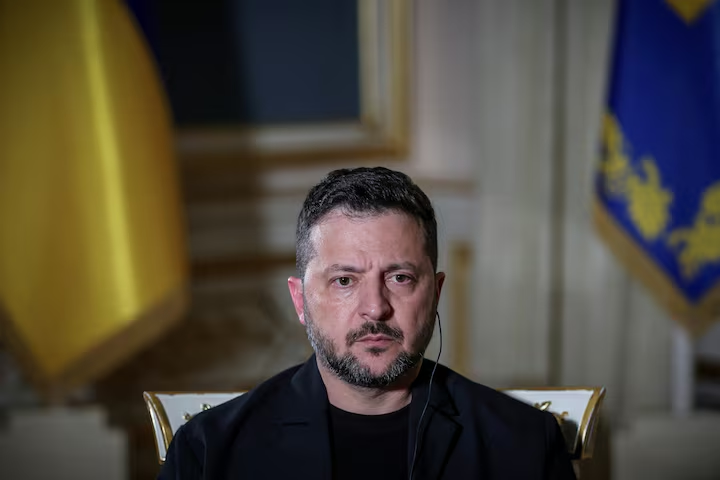
Ukrainian President Volodymyr Zelenskiy said on Sunday, October 11, 2026, that Ukraine will hold national elections if Russia agrees to a 60-day total ceasefire. The offer came during an exclusive interview on ABC’s This Week, just one day after U.S. President Donald Trump told reporters at the White House that Ukraine needed a new leader and blamed Kyiv’s drone strikes on Russian oil refineries for rising diesel prices.
The Zelenskiy 60-day ceasefire elections proposal turns Trump’s criticism back toward Moscow: if Washington wants a vote in Ukraine, the Kremlin first has to stop the bombing. Below, we break down what was said, why diesel prices have pulled the U.S. into the dispute, and what could happen next. For more breaking coverage, visit our U.S. News section.
 Also read10 Online Earning Scams in 2026 and How to Spot Them Before You Pay
In this article
- What Zelenskiy Told ABC’s “This Week”
- Why Trump Called for a New President in Ukraine
- Zelenskiy’s Counteroffer: “Don’t Attack Us, We Stop Hitting Your Diesel”
- Why Diesel Prices Put Ukraine’s War on Every American’s Radar
- Can Ukraine Actually Hold Elections During the War?
- How Allies Are Reacting
- What Happens Next: 3 Scenarios to Watch
- Frequently Asked Questions
- Bottom Line
What Zelenskiy Told ABC’s “This Week”
Speaking with co-anchor Jonathan Karl, Zelenskiy addressed two attacks from the White House at once: the call for him to be replaced and the demand that Ukraine stop hitting Russian refineries.
On the leadership question, he was direct. Zelenskiy said he had already passed a message to Trump’s team, telling them that if they truly wanted elections in Ukraine, they should ask Vladimir Putin for a pause in fighting. In his words to ABC: “Please tell Putin, give us two months, 60 days of total ceasefire.”
Key points from the interview:
- Elections are possible — but only with a full, 60-day halt to Russian attacks so voters can safely reach polling stations.
- The choice belongs to Ukrainians — Zelenskiy said, with respect to Trump, that picking a leader is up to Ukraine’s own society and people.
- Putin wants the same outcome — he pointed out that Moscow has long wanted to change who runs Ukraine, implying Trump’s demand echoes a Kremlin goal.
- Refinery strikes are retaliation — Kyiv says it targets Russian fuel facilities because Russia keeps hitting Ukraine’s power grid.
- A swap is on the table — Ukraine will stop striking Russian diesel infrastructure if Russia stops attacking Ukrainian energy.
Why Trump Called for a New President in Ukraine
The interview followed a sharp escalation on Saturday, October 10. Speaking to reporters, Trump said it was time for Ukraine to get a new president and claimed Zelenskiy “chooses not to” end the war that began with Russia’s full-scale invasion in February 2022.
The core of Trump’s frustration is fuel. Amid a global energy crunch, the president argued that Washington had given Kyiv freedom to act against Russia but had drawn one line: leave the refineries alone. In his view, knocking out Russian refining capacity tightens worldwide supplies of diesel and pushes prices higher for everyone, including American drivers, truckers and farmers.
That argument comes at a politically sensitive moment. Reporting from Australia’s ABC notes that the administration had also temporarily lifted U.S. sanctions on Russian fuel, while Trump faces pressure at home over his handling of the Iran war and high energy prices.
Zelenskiy’s Counteroffer: “Don’t Attack Us, We Stop Hitting Your Diesel”
Rather than simply rejecting Trump’s demand, Zelenskiy reframed it as a two-way deal. He told ABC News that Ukraine has repeatedly told the U.S. it wants peace, is ready for a ceasefire, and is willing to begin with any de-escalation step. His ask was that Trump signal to Moscow to stop striking Ukrainian energy infrastructure.
He summed up the offer in plain terms: “Don’t kill our children. We will stop attack[ing] your diesel.” He called it a fair deal. You can read ABC’s full report on the interview here on ABC News.
The latest update: an energy ceasefire?
The situation moved quickly after the broadcast. According to an updated ABC News report, Trump said on social media after the interview aired that both Ukraine and Russia had agreed to an energy ceasefire. As of Sunday evening, neither Kyiv nor Moscow had published detailed terms, and it was not clear how long such a pause would last or how it would be monitored.
Readers should treat this as a developing story. Earlier limited energy truces in this war proved fragile, with both sides accusing the other of violations within days.
Why Diesel Prices Put Ukraine’s War on Every American’s Radar
It may seem surprising that drone strikes thousands of miles away can shape what Americans pay at the pump, but the link is real. Here is how it works:
- Russia is a major refined-fuel exporter. It sells large volumes of diesel and other products into global markets.
- Refinery hits cut output. When Ukrainian drones damage Russian refineries, Russia produces and exports less finished fuel.
- Global supply tightens. Diesel is traded internationally, so a shortfall in one region lifts prices elsewhere.
- Costs ripple through the economy. Diesel powers trucks, trains, farm equipment and ships, so higher prices feed into the cost of groceries and goods.
For businesses, especially logistics firms, retailers and manufacturers, a lasting energy ceasefire could ease one source of pressure on fuel costs. If you run a small company, our Business coverage tracks how energy and policy shifts hit your bottom line.
Can Ukraine Actually Hold Elections During the War?
Ukraine has been under martial law since February 2022, and Ukrainian law does not allow presidential or parliamentary elections while martial law is in force. That is why the presidential vote originally due in 2024 never took place, and why critics, including Moscow and now Trump, question Zelenskiy’s mandate.
Zelenskiy’s 60-day window reflects practical problems, not just legal ones:
- Security: Millions of voters would gather at polling stations that could be targeted by missiles, drones and glide bombs.
- Displaced citizens: Millions of Ukrainians live abroad or are internally displaced, so arranging their votes takes time.
- Soldiers at the front: Hundreds of thousands of troops would need a way to vote.
- Occupied territory: Residents of Russian-held areas cannot vote freely under occupation.
The danger is not theoretical. On the same Sunday as the interview, a Russian guided bomb struck a residential area of Kharkiv, killing a 35-year-old woman and injuring 10 people, including a child, according to the Kyiv Post.
How Allies Are Reacting
Europe has so far moved in the opposite direction from Washington’s sanctions relief. British Prime Minister Andy Burnham spoke with Zelenskiy on Saturday and assured him that the UK would keep tightening sanctions on Russia, according to a Downing Street spokesperson. Euronews also reported that Zelenskiy stressed Russia alone bears responsibility for the war, and that Kyiv still counts on American support — a point he made carefully while pushing back on Trump. See Euronews’ coverage for the European angle.
The split matters. If the U.S. eases pressure on Russian fuel while Europe tightens it, Moscow gains room to negotiate, and Kyiv loses leverage.
What Happens Next: 3 Scenarios to Watch
- The energy truce holds and expands. If both sides genuinely stop hitting energy targets, it could open the door to the broader 60-day ceasefire Zelenskiy wants, and possibly to an election timeline.
- The truce collapses within days. A pattern seen before: accusations of violations, renewed strikes, and another round of public blame between Washington and Kyiv.
- Moscow rejects a full ceasefire. Russia has historically resisted unconditional pauses, arguing they let Ukraine regroup. A refusal would weaken the case that Zelenskiy is the obstacle to peace.
Whatever happens, the next few days will test whether Trump’s post-interview announcement turns into a verifiable agreement.
Frequently Asked Questions
What did Zelenskiy say about elections on ABC?
He said Ukraine will organize elections if Russia agrees to a 60-day total ceasefire, and that choosing Ukraine’s leader is a decision for Ukrainians.
Why did Trump say Ukraine needs a new president?
Trump accused Zelenskiy of choosing not to end the war and blamed Ukraine’s strikes on Russian refineries for higher global diesel prices.
Has an energy ceasefire been agreed?
Trump said on social media after the interview that Ukraine and Russia had both agreed to an energy ceasefire. Detailed terms had not been published as of Sunday evening.
Why hasn’t Ukraine held an election since 2019?
Ukraine has been under martial law since Russia’s 2022 invasion, and Ukrainian law prohibits national elections while martial law is in effect.
How do Ukrainian strikes affect U.S. diesel prices?
Damaged Russian refineries export less fuel, which tightens the global diesel market and can push prices higher worldwide, including in the U.S.
Bottom Line
Zelenskiy’s message on This Week was simple: Ukraine is willing to vote, but not under bombardment. By tying elections to a 60-day ceasefire and refinery strikes to Russian attacks on Ukraine’s grid, he shifted the burden back to Moscow. Trump’s claim of a new energy ceasefire could be the first real test of that offer. For more updates on global events that move markets and household budgets, keep following our U.S. News coverage, and if rising fuel costs are squeezing your finances, see our guide on personal loans vs credit cards.
