US-Iran War History: From the 1953 Coup to the 2026 Conflict

 Business
 Editor’s note: this article covers an active, fast-moving conflict. It reflects reporting available as of late September 2026 and will need revisiting as events develop. Readers researching current developments should also check a live news source directly, such as Al Jazeera’s rolling coverage.
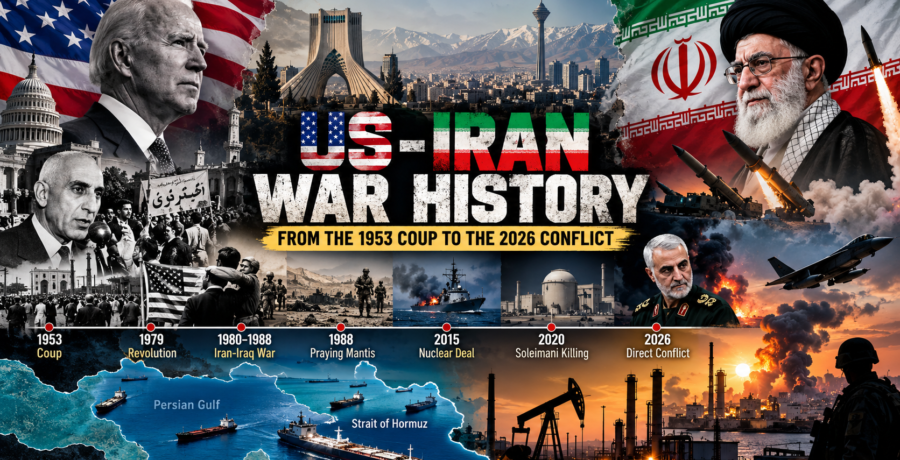
The history of the United States and Iran is far older and more complicated than the phrase “US-Iran war” suggests. For more than seven decades, relations between Washington and Tehran have moved through cooperation, political intervention, revolution, hostage-taking, sanctions, nuclear negotiations, proxy conflict, and — since February 2026 — direct, sustained warfare that remains unresolved as this is written.
US-Iran Relations Before the Modern Conflict
Formal American diplomatic engagement with Persia began in the nineteenth century, with the U.S. State Department recording the first formal act of recognition in 1850 and full diplomatic relations by 1883. At that time, the relationship was primarily commercial. Iran’s position between Europe, the Soviet Union, South Asia, and the Middle East, combined with its large oil reserves, made it strategically important to Western governments, particularly after the Second World War.
The 1953 Iranian Coup
Iranian Prime Minister Mohammad Mosaddegh became associated with nationalizing Iran’s oil industry, directly challenging the British-owned Anglo-Iranian Oil Company. Britain opposed this and drew the United States into the dispute. In August 1953, American and British intelligence helped Iranian military and political forces overthrow Mosaddegh, an operation well documented in declassified U.S. government records. The coup strengthened Shah Mohammad Reza Pahlavi’s position for the next 26 years, but for many Iranians, 1953 became a lasting symbol of foreign interference — a memory that would matter enormously decades later.
The Shah, Opposition, and the Path to Revolution
After 1953, Iran became a major American partner, receiving military equipment and economic support while opposition to the Shah’s rule grew over accusations of repression and excessive Western dependence. Ayatollah Ruhollah Khomeini emerged as a central opposition figure and was eventually forced into exile, while opposition movements steadily gained strength through the 1970s.
The 1979 Revolution and Hostage Crisis
Mass protests forced the Shah to leave Iran in early 1979, and Khomeini returned from exile to lead the new Islamic Republic. On November 4, 1979, Iranian students seized the U.S. Embassy in Tehran, holding more than 50 Americans hostage for 444 days. The United States severed diplomatic relations in April 1980; the hostages were released on January 20, 1981. Formal diplomatic relations have never been restored, a fact worth understanding alongside our broader look at how business continuity planning treats sustained disruption, since prolonged diplomatic rupture is itself a form of institutional discontinuity businesses in the region have had to plan around for over four decades.
The 1980s: Iran-Iraq War and Direct US-Iran Clashes
Iraq invaded Iran in 1980, beginning a war that lasted until 1988 and caused enormous losses. The United States gradually increased support for Iraq while protecting its own regional interests as the Persian Gulf grew more militarized and oil tankers came under attack. In 1988, after an American warship struck a mine, the U.S. launched Operation Praying Mantis, destroying several Iranian naval vessels — one of the most direct pre-21st-century military confrontations between the two countries. That same July, the USS Vincennes shot down Iran Air Flight 655, killing all 290 people aboard after the U.S. Navy said the warship mistakenly identified the civilian aircraft as a threat. Iran has never accepted this as an honest mistake, and the tragedy remains a significant grievance in Iranian public memory.
The 1990s Through the 2015 Nuclear Deal
Through the 1990s and 2000s, American sanctions expanded as Washington accused Iran of supporting militant groups, while Iran’s nuclear program became the central diplomatic dispute with Western governments. Iran has consistently maintained the program serves peaceful purposes, while the International Atomic Energy Agency worked to monitor enrichment activity under Iran’s Nuclear Non-Proliferation Treaty obligations. In 2015, Iran and world powers reached the Joint Comprehensive Plan of Action (JCPOA), restricting Iran’s nuclear program in exchange for sanctions relief — the most significant diplomatic breakthrough in the relationship’s modern history.
2018-2020: Withdrawal, Tanker Attacks, and the Soleimani Strike
In 2018, the Trump administration withdrew the United States from the JCPOA and restored major sanctions under a “maximum pressure” campaign. Iran gradually reduced compliance with nuclear restrictions as the diplomatic gap widened. Tensions in the Persian Gulf increased sharply in 2019, with attacks on commercial vessels and a U.S. drone shot down by Iran. In January 2020, the United States killed IRGC Quds Force commander Qassem Soleimani in a drone strike near Baghdad; Iran responded with missile strikes on U.S. bases in Iraq, but the episode did not immediately escalate into sustained war.
2025: The Twelve-Day War, a Precursor to Wider Conflict
What the earlier version of this article omitted entirely is that 2025 saw its own direct Israel-Iran war, now referred to as the Twelve-Day War, during which Israeli strikes significantly degraded Iran’s air defenses, missile launchers, and nuclear program infrastructure. This 2025 conflict genuinely set the military and political conditions for what followed in 2026 — Iran entered the following year’s confrontation considerably weaker than it had been at any point in the prior decade.
February 28, 2026: The War Begins — and Iran’s Supreme Leader Is Killed
This is the single most significant fact the earlier draft of this article left out entirely. On February 28, 2026, following the breakdown of renewed US-Iran nuclear negotiations, the United States and Israel launched joint strikes against Iran under the operation names Epic Fury and Roaring Lion. The opening wave killed Iran’s Supreme Leader Ayatollah Ali Khamenei, along with the commander of the Islamic Revolutionary Guard Corps, the defense minister, and several other senior officials — an assassination of a sitting head of state-level religious and political authority without precedent in the modern US-Iran relationship. Khamenei’s son was subsequently named as his successor.
According to the Council on Foreign Relations’ conflict tracker, the stated American and Israeli goals included destroying Iran’s ballistic missile capabilities, eliminating its navy, permanently preventing nuclear weapons capability, and severing support for regional proxy forces; President Trump also called publicly for regime change.
The War Expands: Lebanon, the Gulf, and the Strait of Hormuz
Hezbollah, Iran’s main regional ally, launched strikes on Israel on March 2, 2026 in response to Khamenei’s killing, reigniting the Hezbollah-Israel conflict and leading Israel to begin occupying parts of southern Lebanon that same month. Iran itself launched missile and drone strikes against Israel and against U.S. and allied targets across Iraq, Saudi Arabia, Qatar, Kuwait, Bahrain, Oman, and Jordan. NATO forces intercepted Iranian drones and missiles near Turkey’s Incirlik Air Base. The Strait of Hormuz, through which a large share of the world’s traded oil passes, became a central flashpoint, and remains one through the writing of this update.
The June 2026 Islamabad Memorandum — and Its Breakdown
On June 17, 2026, the U.S. and Iranian presidents signed the Islamabad Memorandum, a ceasefire agreement that lifted a dual naval blockade and represented the closest the two sides came to formally ending the war. Tensions escalated again shortly after, though a further agreement on June 28 curbed the direct exchange of attacks for a period. The ceasefire never fully held: disputes over Iran’s nuclear program, sanctions relief, the Strait of Hormuz, and Israel’s continued presence in Lebanon repeatedly reignited fighting through the summer.
Where Things Stand as of Late September 2026
As of this writing, the war remains genuinely active and unresolved. In the past week alone, U.S. envoy Mike Waltz publicly dismissed a new Iranian ceasefire proposal, Iran’s Foreign Minister Abbas Araghchi warned Tehran was prepared for a “doomsday war,” President Trump rejected an Iranian peace proposal to reopen the Strait of Hormuz, and U.S. Central Command reported destroying additional Iranian oil tankers as part of an ongoing naval blockade. Iran has also filed suit against the United States at the Iran-United States Claims Tribunal in The Hague over the legality of the war. Many legal scholars, per continuing analysis tracked on Wikipedia’s Analysis of the 2026 Iran war, argue the U.S. military action lacked the congressional authorization required under American law — a genuinely unresolved legal question running alongside the unresolved military one.
Why the Strait of Hormuz Matters This Much
The Strait is a narrow passage connecting the Persian Gulf to the Gulf of Oman and the wider Arabian Sea, and an enormous share of global crude oil and gas moves through it daily. A U.S. naval blockade combined with Iranian attacks on tankers has already disrupted shipping routes, and continuing disruption genuinely affects crude oil prices, shipping insurance, and — with a lag — inflation and consumer prices well beyond the region.
Why This War Matters to Businesses Far From the Middle East
Businesses don’t need Middle East operations to feel this conflict’s effects. Energy shocks ripple through fuel costs, freight costs, shipping delays, insurance premiums, and currency volatility. For any business managing supply chain or cost exposure to global energy prices, this is genuinely worth treating as an ongoing risk factor rather than a settled historical event — a planning discipline covered in more depth in our guide to business continuity versus disaster recovery planning, where distinguishing a manageable disruption from a genuinely prolonged one shapes very different response plans.
The Human Cost
Behind the strategic analysis are real deaths, injuries, and displacement on multiple sides — Israeli military personnel killed since March 2026, Iranian civilian and military casualties from the initial strikes and subsequent fighting, and Lebanese civilians affected by the renewed Hezbollah-Israel conflict, including damage to schools and infrastructure documented by outlets covering the war’s humanitarian toll. These human consequences persist regardless of how the diplomatic and legal disputes eventually resolve.
A Corrected Timeline
| Date | Event |
| 1953 | US/UK-backed coup removes Mosaddegh; Shah’s rule strengthened |
| 1979 | Islamic Revolution; Shah exiled, Khomeini returns |
| 1979-1981 | 444-day US Embassy hostage crisis |
| 1980-1988 | Iran-Iraq War; US tilts toward Iraq |
| 1988 | Operation Praying Mantis; Iran Air Flight 655 shot down |
| 2015 | JCPOA nuclear deal signed |
| 2018 | US withdraws from JCPOA; sanctions restored |
| 2020 | Qassem Soleimani killed in US drone strike |
| 2025 | Twelve-Day War significantly weakens Iran’s defenses |
| Feb 28, 2026 | US-Israel strikes begin; Khamenei killed |
| March 2026 | Hezbollah strikes Israel; Israel occupies south Lebanon |
| June 17, 2026 | Islamabad Memorandum ceasefire signed |
| Sept 2026 | War ongoing; naval blockade, failed talks, tanker strikes continue |
Could the Conflict Still End Through Diplomacy?
History suggests yes, eventually — the 2015 JCPOA proved Washington and Tehran can negotiate complex agreements despite deep hostility, and the June 2026 Islamabad Memorandum showed the same capacity mid-war. But as of late September 2026, both sides remain publicly far apart: Iran’s government says it has no current plans to meet American officials, while the American envoy has called Iran’s latest proposal cynical. A durable resolution will likely require agreement on Iran’s nuclear program, sanctions relief, the Strait of Hormuz, and Israel’s position in Lebanon simultaneously — a genuinely difficult combination, even by this relationship’s historical standards.
What the Corrected History Teaches Us
First, the 2026 war did not appear from nowhere — it followed both the 2025 Twelve-Day War and decades of accumulated distrust. Second, the killing of a sitting Supreme Leader represents a genuine escalation without real precedent in this relationship’s history, one that fundamentally changed Iran’s internal leadership and its calculus toward negotiation. Third, ceasefires in this conflict have consistently proven fragile rather than final. Fourth, the Strait of Hormuz keeps this a global economic story, not just a regional military one. For readers tracking practical, real-world consequences of this kind of prolonged geopolitical disruption, our coverage of essential cybersecurity practices for businesses is also relevant, since state-linked cyber activity has historically accompanied periods of heightened US-Iran tension.
Frequently Asked Questions
Was Iran’s Supreme Leader Ali Khamenei killed in the 2026 war?
Yes. Khamenei was killed in the opening wave of U.S.-Israeli strikes on February 28, 2026, along with several other senior Iranian officials. His son was named as his successor.
Is the US-Iran war still happening?
As of late September 2026, yes. Naval blockade actions, tanker strikes, and failed ceasefire talks were all reported within the past week, despite a June 2026 ceasefire agreement that never fully held.
What was the Twelve-Day War?
A separate, shorter Israel-Iran conflict in 2025 that significantly degraded Iran’s air defenses and missile capability before the larger 2026 war began.
Is the 2026 war legal under U.S. law?
This is genuinely disputed. Many legal scholars argue it required congressional authorization that was never obtained; the Trump administration has defended the strikes as self-defense under the UN Charter.
How is the war affecting oil prices?
A U.S. naval blockade of the Strait of Hormuz and ongoing tanker strikes have repeatedly moved crude oil prices, with reported gains following failed peace talks as recently as late September 2026.
The Bottom Line
The history of US-Iran relations is a story of shifting alliances, revolution, sanctions, nuclear diplomacy, and — since February 2026 — a war that killed a sitting Supreme Leader and remains genuinely unresolved as of this writing. Given how quickly this specific story continues to move, treat any single account, including this one, as a snapshot rather than a final record, and check a live source such as Al Jazeera’s rolling Iran war coverage or the Council on Foreign Relations’ tracker for the latest developments.
 Business
 Russia vs Ukraine: Full History of the War and Military Power Comparison
 Business
 Nvidia’s $150 Billion Buyback Just Became the Largest in History: What It Signals for the AI Trade
 Business