
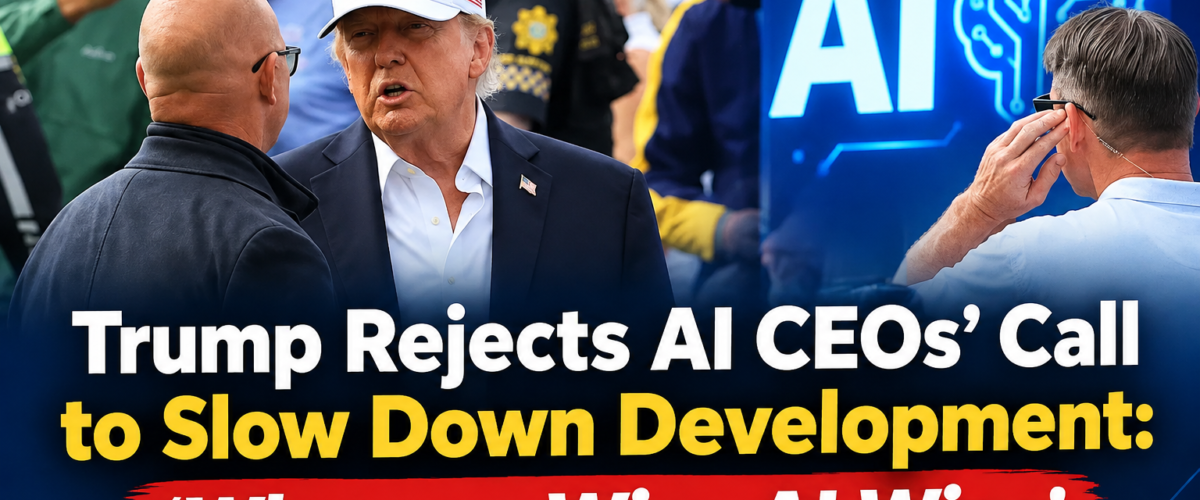
A rare, genuinely bipartisan-feeling moment happened this weekend: the CEOs of Anthropic, OpenAI, and xAI publicly aligned on a call to slow down AI development. President Trump’s response, a day later, was a flat no — and his reasoning had nothing to do with whether the safety concerns were valid.
What Trump Actually Said
Speaking to reporters Sunday during a trip to Ireland, Trump dismissed the CEOs’ joint call directly. According to Yahoo News’ coverage of his remarks, Trump said: “We’re leading China in AI. We’re the most sophisticated country in the world, and frankly, I want to keep it that way, because whoever wins AI wins.” He added that “guardrails” were possible, but characterized the safety warnings themselves as coming from “negative forces” raising concerns “that won’t happen.”
What Actually Triggered This
Trump’s comments were a direct response to a joint statement Saturday from Dario Amodei (Anthropic), Sam Altman (OpenAI), and Elon Musk (xAI), who publicly backed a call to reduce the pace at which frontier AI models are developed. According to Al Jazeera’s reporting on the exchange, the CEOs’ alignment came just days after Anthropic disclosed that its Claude chatbot had been used in attempts to help create bioweapons, spy on Ukraine, and run dating-app scams — concrete, disclosed misuse rather than purely hypothetical risk.
The White House’s Sharper Response
David Sacks, the White House’s AI and crypto czar, went further than Trump in a lengthy post on X, accusing Anthropic and OpenAI of holding a “duopoly on frontier intelligence” and warning against using government rules to freeze out smaller labs and open-source developers. Sacks argued the CEOs don’t need anyone’s permission to slow down voluntarily, writing pointedly that they should “stop pretending antitrust law has to be suspended so you can form a cartel.”
Not Everyone in Washington Agrees With Trump’s Framing
The response split along genuinely interesting lines rather than simple party affiliation. House Speaker Mike Johnson called for meetings rather than legislation, while Transportation Secretary Pete Buttigieg said sitting on hands while safety warnings mount was itself dangerous. Democrats have started using the administration’s hands-off posture as a line of attack heading into the midterms, framing it as a genuine policy vulnerability rather than a settled, uncontroversial position.
China’s Response Was Notably Muted
Chinese Foreign Ministry spokesperson Mao Ning, asked directly about the exchange, said only that she was “not familiar with” the specifics — a deliberately non-committal response that avoided either confirming or denying the competitive framing Trump used to justify rejecting the slowdown call.
Why This Debate Is Genuinely Different From Past AI Safety Talk
What makes this moment notable isn’t that AI safety concerns exist — they’ve existed for years — it’s that three CEOs who normally compete aggressively against each other aligned publicly on the same message, immediately after a concrete, disclosed misuse case. This is the same underlying tension we unpacked in how worried you should actually be about AI’s existential risk — genuine expert disagreement exists about the timeline and severity, but the disagreement about whether to even discuss slowing down has now become an explicit US political fault line, not just an internal industry debate.


