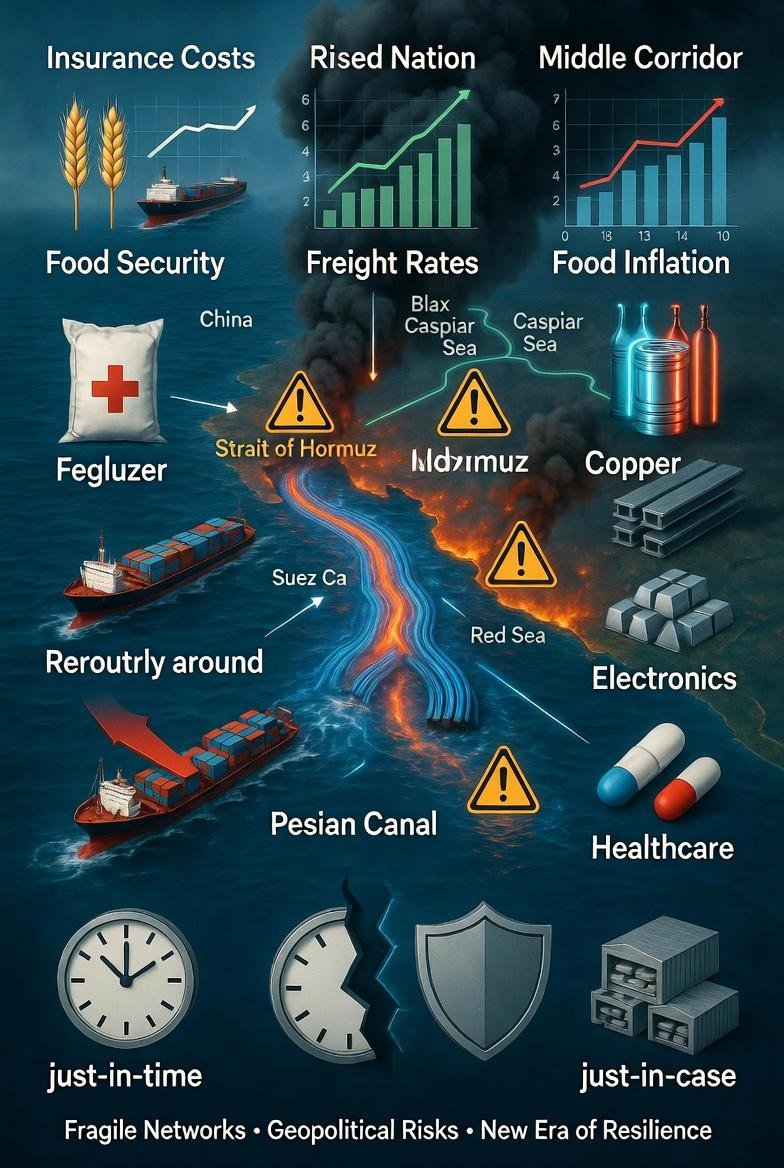
The modern global economy operates on a knife’s edge, reliant on the seamless movement of goods, raw materials, and finished products across vast geographical expanses. For decades, the Persian Gulf region has been viewed primarily through the lens of energy security, with the price of crude oil serving as the primary barometer of economic stability. However, the escalation of geopolitical tensions involving Iran has revealed a far more complex and precarious reality. While the world’s attention remains fixated on fluctuating fuel prices, a quieter, yet equally devastating, disruption is taking place beneath the surface. Critical supply chains upended by the war in Iran besides just oil represent one of the most significant challenges facing manufacturers, agriculturalists, and logistics experts in the current era. The fragility of these networks, built on principles of efficiency and just-in-time delivery, is now being tested by a conflict that threatens the arteries of international trade.
The Historical Context of Trade Routes in the Middle East
To understand the current crisis, one must first appreciate the historical significance of the region as a commercial crossroads. The Middle East, and particularly the Strait of Hormuz, has served as a conduit for trade between Asia, Africa, and Europe for millennia. Modern infrastructure, including massive port facilities in the United Arab Emirates, sophisticated rail networks, and high-capacity highways, has transformed the region into a hub for global logistics.
Iran’s strategic geography places it at the center of this network. Bordering the Caspian Sea to the north and the Persian Gulf to the south, the nation has long been a critical transit corridor for landlocked Central Asian states seeking access to open waters. When geopolitical stability is compromised, the ripple effects extend far beyond the immediate conflict zone, impacting global trade networks that rely on the predictability of these routes.
The Shift from Energy Dependency to Diversified Supply Chains
In the past, a crisis in the region would primarily trigger concerns about gasoline prices at the pump. Today, the interconnected nature of global supply chains means that a disruption in this area affects everything from the price of steel in Europe to the availability of semiconductor components in East Asia. Investors and corporate strategists are now forced to evaluate risks not just in terms of energy costs, but in terms of the physical movement of diverse goods.
Disruptions in Global Food Security
One of the most alarming consequences of the instability surrounding Iran is the threat to global food security. While the region is often perceived as arid and agriculturally limited, it plays a vital role in the global food supply chain through its control of key shipping lanes and its status as a major producer and transit hub for specific agricultural commodities.
The Role of the Black Sea and Caspian Sea Corridors
The conflict dynamics involving Iran intersect with the ongoing disruptions in the Black Sea region. The Caspian Sea, which Iran shares with nations like Kazakhstan and Russia, serves as a crucial alternative route for grain exports. Kazakhstan, one of the world’s leading wheat producers, relies heavily on Iranian ports such as Bandar Anzali and Bandar Abbas to ship grain to international markets. Instability along these routes, whether due to insurance premiums skyrocketing or physical infrastructure being targeted, creates bottlenecks.
When logistics are delayed, it exacerbates food inflation globally. Developing nations in the Middle East and North Africa (MENA) region, which import the majority of their food requirements, find themselves in a precarious position. A disruption in this corridor means that essential staples like wheat, barley, and sunflower oil become subject to bidding wars, pushing basic sustenance out of reach for vulnerable populations.
Fertilizer and Agrochemical Supply Chains
Beyond the grain itself, the region is a critical supplier of potash, phosphate, and nitrogen-based fertilizers. Iran and its neighboring countries possess significant chemical and petrochemical industries that produce the agricultural inputs necessary for crop production worldwide. Critical supply chains upended by the war in Iran besides just oil include these vital fertilizer supply routes.
When shipping lanes through the Persian Gulf become unsafe or when sanctions are tightened, the flow of these agrochemicals is disrupted. Farmers in Europe, South America, and South Asia suddenly face shortages or inflated prices for fertilizers. This leads to reduced crop yields, which in turn creates a secondary shock to the global food system months after the initial logistical disruption. It is a chain reaction where geopolitical tension in one region translates directly into hunger or financial strain in another.
The Strain on Industrial Raw Materials
While oil dominates headlines, the industrial raw materials that pass through or originate from the region are equally vital to the global manufacturing sector. Iran possesses significant reserves of various minerals and metals that are essential for modern technology and green energy transitions.
Steel, Aluminum, and Copper
Iran is a major producer of steel and aluminum in the Middle East. The country’s annual production of crude steel exceeds 30 million tons, much of which is exported to markets in Asia and the Middle East. The war-related tensions, including naval confrontations in the Strait of Hormuz and the imposition of stringent logistics controls, have created extreme volatility in the metals market.
Copper, another critical industrial metal used extensively in electronics, construction, and electric vehicle (EV) manufacturing, is also affected. While Iran is not the largest global producer, the instability in the region affects shipping routes that carry copper from other major producers, such as Kazakhstan and Uzbekistan, to global markets. Insurers often increase premiums for vessels transiting the Strait of Hormuz, making it prohibitively expensive to ship heavy industrial goods, effectively pricing them out of the market or causing delays that halt assembly lines in distant factories.
The Rare Earth Element Conundrum
As the world pivots toward renewable energy and electric vehicles, the demand for rare earth elements and specific minerals used in batteries has skyrocketed. While these materials are primarily associated with China, the transit routes for processed minerals often pass through the Persian Gulf. The uncertainty surrounding maritime security in the region adds a layer of risk to the already complex supply chain for lithium-ion batteries and high-performance magnets.
The Maritime Logistics Nightmare
The physical movement of goods relies on the predictability of maritime insurance and shipping routes. The Strait of Hormuz, a narrow waterway separating Iran from the Arabian Peninsula, is the world’s most important chokepoint for maritime trade. Approximately 20-30% of the world’s petroleum and a significant portion of liquefied natural gas (LNG) pass through this strait. However, the impact on container shipping and bulk carriers is often underreported.
Rising Insurance and Freight Costs
Following any escalation in the region, the maritime insurance industry, centered in London and other global hubs, immediately reassesses risk. The area around the Strait of Hormuz is frequently designated as a “Listed Area” by insurance underwriters, leading to a dramatic increase in what is known as “war risk premiums.” These costs are passed directly to the consumer.
For a container ship carrying consumer electronics, pharmaceuticals, or automotive parts from Asia to Europe, the additional cost of navigating these waters can add tens of thousands of dollars to the voyage. This inflation of shipping costs contributes to broader inflationary pressures across the global economy. Moreover, shipping lines may opt to reroute vessels around the Cape of Good Hope, adding 10-14 days to transit times, effectively reducing the available capacity in the global container fleet and causing congestion in alternative ports.
Port Congestion and Infrastructure Pressure
The ports in the United Arab Emirates, such as Jebel Ali in Dubai, serve as critical transshipment hubs for the region. However, when instability rises, these ports face the dual challenge of managing diverted traffic while maintaining security protocols. The slowdown in vessel turnaround times creates a domino effect. Cargo destined for Europe or North America gets stuck in the middle of the supply chain, causing shortages of specific components in manufacturing hubs like Germany or South Korea.
The Impact on Technology and Semiconductor Supply Chains
In the 21st century, the semiconductor chip has become as vital as oil. The global chip shortage of the early 2020s demonstrated how reliant modern life is on these tiny components. The disruption of supply chains near Iran affects the semiconductor industry in ways that are not immediately obvious.
Specialized Gases and Chemicals
The production of semiconductors requires an extraordinarily clean environment and the use of specialized industrial gases and chemicals. The Middle East is a significant producer of these precursor materials. For instance, the region produces a substantial portion of the world’s neon, krypton, and xenon—gases essential for the lasers used in chip lithography. While the supply of these gases is often associated with the Black Sea region, the instability in Iran exacerbates the logistical challenges of moving these hazardous and specialized materials.
Furthermore, the raw materials for the inert gases used in semiconductor fabrication sometimes transit through the Persian Gulf. Any disruption in these logistics pipelines can result in production delays for chip manufacturers in Taiwan, South Korea, and the United States, ultimately affecting the availability of everything from automobiles to medical devices.