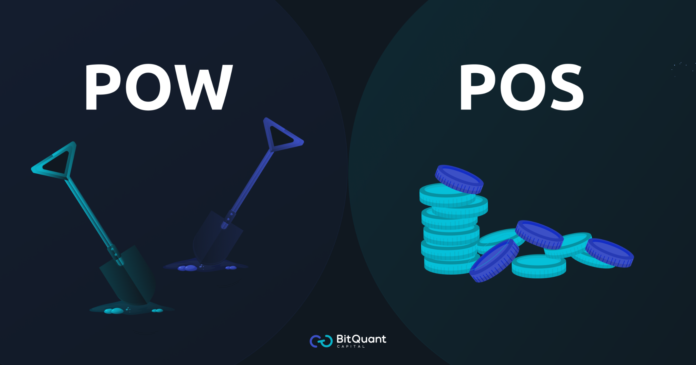
There is hardly any crypto enthusiast unfamiliar with the concepts of Proof of Work and Proof of Stake. Just like coffee or tea adopters, in the crypto world, people either support Proof of Work or Proof of Stake, and controversy concerning PoW vs PoS persists in establishing superiority. Consensus mechanisms are designed to validate transactions without the involvement of intermediaries and safeguard against double-spending. They play a crucial role in providing data safety, reliability, and governance in blockchain to make it a decentralized system. But approaches to reaching the consensus may vary, so there are many other consensus algorithms besides PoS and PoW. However, these two remain the most commonly used consensus mechanisms. So, delve into our article to learn more about PoS and PoW. We’ll explore each consensus mechanism in detail and explain the difference between Proof of Stake and Proof of Work.
What is Proof of Work?
The Proof of Work consensus mechanism leverages hardware capabilities and powerful computers to validate cryptocurrency transactions and add them to the blockchain. Miners, equipped with computational power, try to solve intricate mathematical puzzles, and the first one to do that gains the right to add a new block of transactions and is rewarded. However, over time, the reward a miner receives for creating a block decreases due to a process known as halving. This event occurs approximately every four years or after every 210,000 blocks, halving the reward. The most recent halving occurred in May 2020, reducing the block reward to 6.25 Bitcoins. The PoW algorithm remains widely employed in numerous cryptocurrencies, including Bitcoin, Litecoin, Dogecoin, and Monero.
What is Proof of Stake?
Proof of Stake stands as one of the primary alternatives to Proof of Work, meticulously designed to address the limitations of PoW, such as scalability and energy consumption. While both consensus mechanisms strive to achieve agreement on the blockchain, in the Proof of Stake algorithm, validators are selected based on their cryptocurrency holdings and the number of coins they have staked. This selection process occurs randomly, yet a larger stake of coins enhances the likelihood of being chosen to validate transactions and earn transactional fees as a rewarding incentive. Prominent blockchain platforms, including Ethereum, Cardano, Tezos, and Cosmos, have successfully deployed PoS as their consensus mechanism.
Difference Between Proof of Work and Proof of Stake
Now that you are acquainted with the fundamentals of these consensus mechanisms, we understand your eagerness to determine the champion in the Proof of Stake versus Proof of Work battle. Let us delve into a comprehensive comparison of both approaches without further ado.
| Criteria | PoW | PoS |
| Concept | Miners compete in solving complex mathematical puzzles to get the right to validate transactions. Powerful hardware plays a key role. | More staked coins give the node more chances to validate the transaction. |
| Block validation | The first miner to solve the puzzle using computational power gets to add a new block | The validators are chosen randomly |
| Security | To gain control over the network, malicious miners must take 51% of hashing control. | Attackers must stake 51% of the total assets to control the network. |
| Decentralization | Mining pools create a risk of centralization | By favoring those, who hold significant amounts of coins, PoS has a risk of centralization |
| Scalability | It has some scalability issues, as block creation takes a considerable amount of time | Fast block time enables the scalability process to be easier |
| Transaction speed | ~ 20 transactions per second | ~ 100,000 transactions per second |
| Energy Efficiency | The most energy-consumption consensus | Considered to be energy-efficient |
PoS vs PoW: So Which One is Better?
As you can see, Proof of Work and Proof of Stake have pros and cons. Therefore, the question of which one to choose remains open. When deciding between PoW vs PoS, it’s essential to consider the specific needs of your project. You might even want to explore the possibility of using another consensus mechanism. However, regardless of the choice for your token, it’s crucial to remember that it’s not the only factor that determines success. Liquidity plays a vital role in every token project. Without it, the project is likely to fade away quickly.
That’s where BitQuant Capital comes in. As a reliable crypto market maker and liquidity provider, BitQuant Capital ensures that your token will experience a surge in value. This top-tier company offers exceptional market-making services to token projects and crypto exchanges. Book a meeting today to discover how BitQuant Capital can help you take your project to new heights!