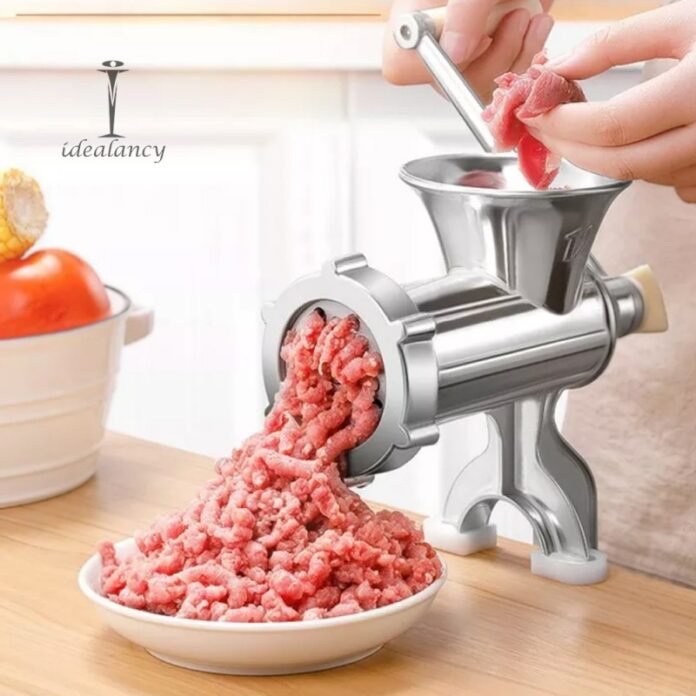
During meat processing, occasionally, one wants to ground it for various reasons. To achieve this, one needs an appliance that can perform the task, as it can take a lot of work to achieve that by hand. Meat-mincing appliances have undergone quite some evolution, and currently, meat mincers are used both commercially and in homes.
This article will focus on meat mincers, specifically their uses, types, and factors to consider when purchasing one. The article will be beneficial to those who may be contemplating purchasing one.
How does a meat mincer work?
A mincer consists of many components that aid in mincing; these include a grinder body, grind worm, grinding blade, and grinding plate, the key components, among others. There may be some variations across brands. When food is introduced into the mincer, it enters the grind warm – which may also be referred to as a screw conveyor – here, it is smashed and conveyed to the grinding blade, which further finely slices it as it is pushed out of the mincer through the grinding plate. The fineness of the product largely depends on the sizes of the holes on the plate.
Uses of a meat mincer
A mincer is very useful when finely cut foodstuffs are required; it is commonly used to chop meat. It can also come in handy when you want to mix food, whether cooked or not. Course-ground products such as hamburgers, meatballs, sausage, and beef hash are made from minced raw material. The mincer can also be very useful in grinding bones that can be used to prepare bone meals or even dog food.
Types of meat mincers
In the market, there are two types of mincers, these are, either manually driven ones or electrically driven ones. Both achieve the same results with different driving mechanisms.
Manual meat mincers
Such mincers have a crank, which is turned by hand to enable the meat or whichever food to be passed through and be ground. They are usually clamped on the table for stability. An average person can mince about 1 to 1.5 kilograms of meat per minute, but this will also depend on the type of meat.
Electric meat mincer
This is relatively more complex in design than the hand-driven one. They are equipped with an electric motor that drives the meat mincer. The electric mincer is faster, more powerful, and relatively safer than the manual one.
Considerations when purchasing one
When planning to purchase a meat mincer machine, this decision rolls down to individual preference. Factors such as the cost, availability of a good source of electricity, and where it will be used play a vital role in the decision. Electric ones will be preferred for commercial use where large volumes of products are processed. Manual ones will be preferred where the electricity supply is unreliable and a few products are processed. In terms of prices, because of its complexity, an electric one is more expensive than the manual one, and it may also take a toll on your electricity bill.
Conclusion
Meat mincers are valuable appliances for both home and commercial use. Mincers help process meat and other foodstuffs to prepare delicious dishes for your family and client.