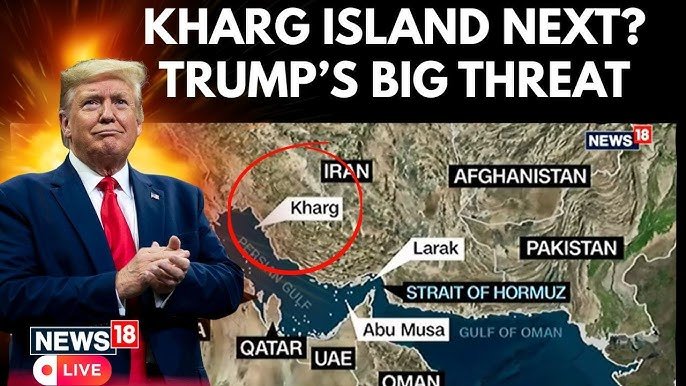
The waters of the Persian Gulf have long served as a barometer for global stability, where the movement of a single oil tanker can send ripples through international markets. In recent political discourse, few scenarios have sparked as much contention and strategic analysis as the hypothetical or threatened disruption surrounding Iran’s primary oil export terminal. This complex issue has crystallized into what is now widely referred to as the Kharg Island seizure debate Trump Iran. This debate is not merely about a piece of land; it encapsulates the fraught history of U.S.-Iran relations, the legacy of maximum pressure campaigns, and the delicate balance of energy security that underpins the global economy. To understand the gravity of this discussion, one must first appreciate that Kharg Island is not just a strategic point on a map—it is the economic jugular of the Islamic Republic, and by extension, a potential flashpoint for international conflict.
In this article
- The Historical Significance of Kharg Island
- The Trump Administration’s “Maximum Pressure” Doctrine
- The Counter-Arguments: Escalation and Entanglement
- International Law and the Question of Legitimacy
- The Role of the Islamic Revolutionary Guard Corps (IRGC)
- Economic and Business Implications
- Diplomatic Alternatives and Future Outlook
- The Human and Environmental Cost
- Conclusion: A Debate Without Easy Answers
The Historical Significance of Kharg Island
Kharg Island, located approximately 25 miles off the coast of Iran in the northern Persian Gulf, is a narrow, coral-fringed island that has served as Iran’s primary oil export and storage hub for decades. Its importance cannot be overstated; before the imposition of severe sanctions, the island’s facilities handled the vast majority of Iran’s crude oil exports. The infrastructure on the island, including massive storage tanks, jetties capable of accommodating supertankers, and underwater pipelines connecting to the mainland, represents a multi-billion dollar asset critical to the nation’s fiscal health.
Historically, the island has been a target during times of conflict. During the Iran-Iraq War in the 1980s, the “Tanker War” phase saw repeated attacks on vessels and facilities near Kharg Island, as Saddam Hussein attempted to cripple Iran’s economy. That era set a precedent: disrupting the flow of oil from Kharg is seen as a viable, albeit highly escalatory, tactic to pressure Tehran. In the current context, the Kharg Island seizure debate Trump Iran rekindles these memories of the 1980s, asking whether a modern, more technologically advanced military could achieve what Iraq could not: neutralizing Iran’s ability to export oil, thereby forcing a change in its geopolitical behavior.
 Also readI Tested 20 Free and Paid Video Editing Tools in 2026 — Here’s Which One Actually Fits You
The Infrastructure and Vulnerability
From an infrastructural perspective, Kharg Island presents both strength and vulnerability. On one hand, it is heavily fortified with air defense systems, naval bases, and is surrounded by the Islamic Revolutionary Guard Corps (IRGC) Navy. On the other hand, its critical role creates a single point of failure. Should the island’s loading facilities be disabled or seized, Iran would lose its primary revenue stream almost overnight. Analysts suggest that while Iran has developed alternative, albeit smaller, export routes via Jask port on the Gulf of Oman, these cannot match the capacity of Kharg. This centralization makes the island an irresistible focal point for policymakers considering coercive measures.
The Trump Administration’s “Maximum Pressure” Doctrine
To fully grasp the nuances of the Kharg Island seizure debate Trump Iran, one must revisit the foreign policy framework established during the Trump presidency. Following the unilateral withdrawal from the Joint Comprehensive Plan of Action (JCPOA) in 2018, the administration of President Donald Trump initiated a “maximum pressure” campaign aimed at reducing Iran’s oil exports to zero. This strategy relied heavily on secondary sanctions, threatening any entity that did business with Iran with exclusion from the U.S. financial system.
The policy was remarkably effective in reducing Iran’s oil revenue, but it also created a prolonged state of military tension. Throughout 2019 and 2020, the region witnessed a series of escalating incidents: attacks on tankers in the Gulf of Oman, the downing of a U.S. Global Hawk drone, and missile strikes on U.S. bases in Iraq. It was during this period that the concept of a physical military operation—specifically the seizure or destruction of Kharg Island—moved from theoretical war games to rumored contingency plans.
The Rationale Behind the Seizure Concept
Proponents of a hardline stance during the Trump era argued that sanctions alone were insufficient to curb Iran’s regional activities, which included support for proxy militias in Iraq, Syria, Lebanon, and Yemen. They posited that a surgical operation to seize Kharg Island would serve three purposes:
- Economic Decapitation: It would immediately strip the Iranian government of its primary source of foreign currency.
- Demonstration of Force: It would signal that the United States was willing to use overwhelming military might to protect international shipping lanes and enforce economic restrictions.
- Bargaining Chip: It would provide the U.S. with a tangible asset to trade in negotiations for a more comprehensive nuclear and missile deal.
However, the debate surrounding this strategy is ferocious, pitting military pragmatists against diplomats and regional security experts who warn of the catastrophic consequences of such an operation.
The Counter-Arguments: Escalation and Entanglement
While the strategic allure of crippling Iran’s oil exports is clear, the Kharg Island seizure debate Trump Iran is dominated by the question of escalation. Critics of the seizure concept argue that it fundamentally misunderstands Iranian strategic culture. Tehran has repeatedly stated that any attack on its territorial integrity—especially on critical energy infrastructure—would be met with a devastating response that would not be confined to the Persian Gulf.
Unconventional Warfare and Regional Proxies
Iran’s military doctrine relies heavily on asymmetric warfare. The IRGC has invested decades in developing the capability to close the Strait of Hormuz, through which approximately 20% of the world’s petroleum passes. While the U.S. Navy is superior in conventional warfare, Iran possesses a vast arsenal of anti-ship ballistic missiles, naval mines, and swarms of small attack craft. Furthermore, Iran’s network of non-state allies across the Middle East provides it with multiple levers to retaliate.
If Kharg Island were seized, the immediate Iranian response would likely involve:
- Attacks on U.S. bases in Iraq, Syria, and the Gulf states.
- Sabotage of Saudi and Emirati oil infrastructure, similar to the 2019 Abqaiq–Khurais attack, which temporarily knocked out half of Saudi Arabia’s oil production.
- Harassment and targeting of commercial shipping, driving up global insurance premiums and oil prices.
- Potential missile strikes aimed at U.S. naval assets in the region.
This dynamic creates a classic “escalation spiral.” What might begin as a limited operation to seize an island could rapidly expand into a full-scale regional war, drawing in Gulf Arab states, Israel, and potentially other global powers. The economic disruption resulting from such a conflict—with oil prices potentially spiking to record highs—would be felt globally, undermining the very stability the operation was meant to secure.
International Law and the Question of Legitimacy
Beyond military feasibility and strategic risk, the Kharg Island seizure debate Trump Iran also involves complex questions of international law. The United Nations Charter generally prohibits the use of force against the territorial integrity of a sovereign state unless in self-defense against an armed attack.
Under the Trump administration, legal justifications for escalating military action were heavily debated. While the U.S. cited attacks on shipping and the need to protect freedom of navigation as potential grounds for self-defense, the seizure of territory—especially a vital economic asset like Kharg—would be widely viewed internationally as an act of war. Such an action would likely fail to garner support from key allies in Europe and Asia, who have historically favored diplomatic engagement over military confrontation with Tehran.
The Impact on Global Energy Markets
For the global business community, the seizure of Kharg Island represents a nightmare scenario. The island’s disruption would effectively remove between 1.5 and 2.5 million barrels per day (bpd) of Iranian crude from the market—or more, if the conflict spread to neighboring producers. The immediate consequence would be a volatility spike in oil prices, potentially surpassing $100 to $150 per barrel.
Such instability has profound implications for global business. For industries reliant on stable energy costs, from logistics to manufacturing, this volatility translates into increased operational costs and uncertainty. Investors typically flee to safe havens during such periods, leading to stock market fluctuations and capital flight from emerging markets. The interconnected nature of modern finance means that a conflict in the Persian Gulf would quickly cascade into supply chain disruptions, inflationary pressures, and a potential global economic slowdown.
The Role of the Islamic Revolutionary Guard Corps (IRGC)
Central to the Kharg Island seizure debate Trump Iran is the role of the IRGC. Unlike conventional militaries, the IRGC is not just a defense force; it is a dominant political, economic, and ideological institution in Iran. Its control over the country’s strategic assets, including the security of Kharg Island, means that any confrontation there is not merely a military engagement but a direct challenge to the regime’s survival.
The IRGC has repeatedly demonstrated its willingness to absorb significant punishment and retaliate asymmetrically. For them, Kharg Island is not just infrastructure; it is a symbol of national sovereignty. The psychological impact of losing the island would be immense, potentially leading to internal instability. However, it might also unify the regime and the populace against an external aggressor, a phenomenon known as the “rally ‘round the flag” effect, which would complicate any U.S. objective of regime change or political capitulation.
Technological Dimensions: Cyber and Naval Warfare
In the modern era, any conflict involving Kharg Island would not start or end with physical boots on the ground. The debate has increasingly shifted toward the cyber domain. Both the U.S. and Iran have robust offensive cyber capabilities. Prior to any physical seizure, there would likely be a prolonged cyber campaign aimed at disabling the island’s radar systems, communication networks, and oil loading automation.
Similarly, naval strategy has evolved. The U.S. Navy has emphasized the concept of “Distributed Maritime Operations,” moving away from large, vulnerable carrier strike groups to a more dispersed network of smaller, more lethal vessels. Conversely, Iran has invested heavily in autonomous underwater vehicles (AUVs) and drone swarms designed to overwhelm traditional naval defenses. This technological evolution makes the outcome of any engagement near Kharg Island highly unpredictable, adding another layer of complexity to the debate.
Economic and Business Implications
From a business and market analysis perspective, the potential for a Kharg Island seizure forces companies to confront extreme geopolitical risk. For multinational corporations with interests in the Gulf region, the debate has necessitated the creation of robust contingency plans.
Energy Sector Resilience
For energy companies, the debate underscores the fragility of global supply chains. Following the 2019 attacks on Saudi Aramco facilities, there has been a push for greater energy resilience, including increased storage capacities and diversification of supply sources. The Kharg Island seizure debate Trump Iran acts as a stark reminder that energy security cannot be taken for granted. Investors in the oil and gas sector often view geopolitical risk as a double-edged sword: while it introduces volatility and potential supply disruptions, it can also lead to higher prices and increased investment in alternative energy infrastructure, such as liquefied natural gas (LNG) export terminals in the United States and Qatar.
Insurance and Shipping
The shipping and insurance industries are also deeply engaged in this debate. The cost of war risk insurance for vessels transiting the Persian Gulf would skyrocket in the event of hostilities. Following the tanker attacks in 2019, shipping companies rerouted cargoes, and insurance premiums increased tenfold. A full-scale confrontation involving Kharg Island would likely lead to a sustained period of high-risk navigation, forcing many shipping lines to avoid the Strait of Hormuz altogether, relying instead on overland pipelines or longer routes around the Arabian Peninsula.
Diplomatic Alternatives and Future Outlook
Despite the heated nature of the Kharg Island seizure debate Trump Iran, many experts advocate for diplomatic pathways that achieve U.S. objectives without triggering a war. The core of the debate revolves around the question: Is it possible to effectively contain Iran’s nuclear ambitions and regional influence without resorting to the seizure of its economic lifeline?
The Nuclear Dimension
The nuclear issue is inextricably linked to Kharg Island. Iran’s nuclear program has advanced significantly since the collapse of the JCPOA. Critics of the seizure option argue that attacking Kharg would effectively end any possibility of a diplomatic resolution to the nuclear impasse. It would likely drive Iran to withdraw from the Non-Proliferation Treaty (NPT) and accelerate efforts to weaponize, arguing that it needs a nuclear deterrent to protect itself from external aggression.
Conversely, supporters of the hardline approach argue that only by creating an existential economic threat—such as the loss of Kharg—can the international community force Tehran to accept stringent, permanent limitations on its nuclear program. This philosophical divide lies at the heart of the current policy paralysis. Strategies for navigating market volatility during geopolitical crises: Market Analysis
The Role of Internal Resources for Businesses
For entrepreneurs and business leaders seeking to navigate the complexities of such geopolitical instability, understanding the broader landscape is crucial. The intersection of international politics and market dynamics is a core theme in reliable business analysis. For instance, staying informed on What Is Business? resilience in the face of external shocks is fundamental. A deep understanding of market analysis helps businesses anticipate supply chain disruptions, while insights into growth strategies allow firms to pivot and identify new markets when traditional corridors are threatened by geopolitical strife. Long-term planning for entrepreneurs facing supply chain disruptions: Growth Strategies
The Human and Environmental Cost
No discussion of the Kharg Island seizure debate Trump Iran would be complete without addressing the potential human and environmental catastrophe. Kharg Island is not just a military target; it is home to a civilian population and sits atop one of the largest concentrations of crude oil storage in the world.
Environmental Disaster
A military engagement on the island carries a high risk of massive oil spills. The storage tanks and pipelines, if hit by missiles or sabotaged, could release millions of barrels of oil into the Persian Gulf. The shallow, semi-enclosed nature of the gulf means that such a spill would devastate marine ecosystems, desalination plants that provide drinking water to millions of people in the region, and the fishing industry. Cleaning up a spill in a warzone would be nearly impossible. This environmental risk adds a moral and humanitarian dimension to the debate that is often overlooked in purely strategic calculations.
Civilian Casualties
Furthermore, the seizure of the island would involve ground combat, likely resulting in significant casualties among both military personnel and civilians. The long-term occupation of the island would require a sustained military presence, making it a persistent target for Iranian retaliation, including guerrilla warfare and suicide drone attacks. The human cost of such a prolonged engagement would be immense, potentially leading to a quagmire reminiscent of other Middle Eastern interventions.
Conclusion: A Debate Without Easy Answers
The Kharg Island seizure debate Trump Iran encapsulates the most challenging aspects of 21st-century geopolitics. It is a debate where military capability meets diplomatic feasibility, where economic pressure clashes with the risk of uncontrollable escalation. On one side stands the argument for decisive action: that until Iran’s primary source of revenue and its ability to threaten regional stability are physically dismantled, the Islamic Republic will continue to destabilize the Middle East and pursue nuclear capabilities that threaten global security.
On the other side stands the argument for restraint: that the seizure of Kharg Island would be an act of war that would unify the Iranian populace against the West, trigger a devastating retaliation through proxies and missiles, shatter global oil markets, and potentially ignite a wider regional conflagration that no nation truly desires. The historical precedent of the Tanker War in the 1980s serves as a cautionary tale; despite years of conflict, Iraq failed to permanently cripple Iran’s oil exports, and the war ended in a stalemate after hundreds of billions of dollars in damage and hundreds of thousands of casualties.
As the global community continues to grapple with Iran’s nuclear advancements and regional ambitions, the debate surrounding Kharg Island remains a litmus test for how far the international community is willing to go. For business leaders, policymakers, and citizens, understanding the stakes—the economic, military, and human costs—is essential. Ultimately, the debate forces a fundamental question: In an interconnected world where energy security, financial stability, and human life are intertwined, can any single military action, even one as strategically targeted as the seizure of Kharg Island, produce a stable and desirable outcome? Or does the complex web of global interdependence render such a move too costly to contemplate, leaving diplomacy, sanctions, and deterrence as the only viable, albeit imperfect, tools of statecraft? The answer to that question will likely define the security landscape of the Persian Gulf for the next generation. To understand the geographical and historical context of the Strait of Hormuz and its significance in global energy trade, you can refer to this external resource: Strait of Hormuz – Wikipedia